
There is more to California than just Silicon Valley and Hollywood. The state has earned many “first place” medals. California boasts the largest standalone state economy in the U.S., weighing in at $4.0 trillion, good enough to rank as the 5th largest economy on Earth, right between Japan and India.14 California also hosts the most jobs in the U.S., employing 12% of the total U.S. labor force, and has added 223,600 jobs in the past 12 months, making it second in the U.S. California is also a hub for start-ups, receiving the most venture capital investment deals in the second quarter of 2024—partly driven by the AI boom.15 Perhaps more interestingly, California is the single largest wine producer in the U.S., responsible for about 80% of the country's overall wine production.16

Point of View Q3 2024
The Gundo: A “Hard Tech” Renaissance Along A California Beach That May Fuel The Next Wave Of American Growth
Subscribe to the Point of View
Sign upBy clicking “Sign Up”, you agree to the relevant privacy policy for your location and consent to receive updates.
It’s popular to say, “Firms and families are fleeing California.”
The data supports this claim. People are leaving the Golden State for the first time (see Figure 1). After more than a century of consistent annual population growth, California lost residents in 2019, 2021, 2022, and 2023.
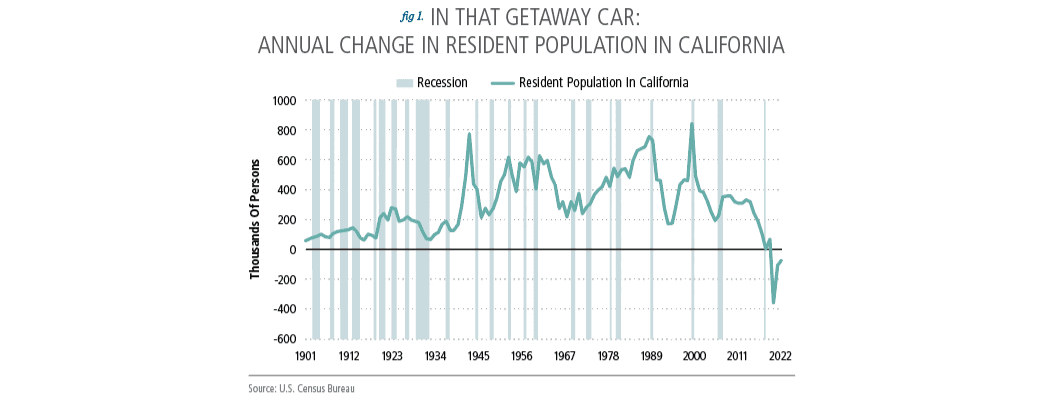
Companies have also left the Land of Milk and Honey. From 2018 to 2021, 352 companies left California for greener pastures.1 The exodus included 11 Fortune 1,000 companies and hundreds of smaller ones.
Perhaps as a result, California's unemployment rate was 5.2% as of May 2024—over a percentage point above the national average.2
But amid the gloom, something interesting is always happening in California (see Did You Know? Box: Going Going, Back Back, To Cali Cali). We should know because Payden & Rygel was founded 41 years ago in Los Angeles, and we’ve heard murmurings of exciting things happening in our backyard.
Did You Know?
Going Going, Back Back, To Cali, Cali
What exactly have we heard, and where is it happening? It’s “hard tech.” And, it is in El Segundo. Or “The Gundo” for short. Here’s the story.
El Segundo? Say What?
El Segundo, California, is a sleepy, surf-side town on the southern Santa Monica Bay in Los Angeles County. With only 17,272 residents, the city covers just 5.5 square miles.3
The city borders the Los Angeles International Airport (LAX); perhaps it’s most famous as the home of the Los Angeles Lakers practice facility, but El Segundo is enjoying a renaissance of “hard tech” start-ups.
The moniker “hard tech” is meant to distinguish local companies working on hardware from Silicon Valley software startups and behemoths.
While El Segundo may seem like an odd locale in which to build an innovation cluster, its history suggests otherwise. The city was founded in 1911 as the site of the second Standard Oil (now Chevron) refinery in the U.S. “El Segundo” is Spanish for “The Second.”4
Agglomeration economies quickly spread, as easy access to fuels attracted automobile producers (Ford in 1914 and General Motors in 1936) and aircraft manufacturers (including Northrop Corporation and McDonnell Douglas [which later merged with Boeing] in the early 1930s).5
There’s a reason the airport is where it is. People often denigrate California as “a terrible place to live—except for the weather.” Yet the mild weather year-round allowed for aerial experimentation, enabling aerospace to flourish. With proximity to the busiest sea port on the West Coast, El Segundo was well-positioned for its first manufacturing boom during World War II and its second during the race to the Moon.
Top scientists and engineers flooded into El Segundo and the surrounding areas. Between 1950 and 1970, the populations of major cities in the South Bay more than doubled.
A former engineer in El Segundo recalled that in the 1970s, “when you went out [in El Segundo], almost everyone you met worked for one of the big [aerospace] companies.”6
The Legend Of Smoky Hollow
It’s no surprise, then, that the Apollo and Space Shuttle programs originated in El Segundo’s “Smoky Hollow” area, which spans 120 acres from Indiana Street and LA’s famed Sepulveda Boulevard to the east, downtown El Segundo to the west, the Chevron facility to the south, and residential neighborhoods to the north.
Space nerds may protest that the nearby town of Downey was home to Apollo and the Space Shuttle orbiters. Although true, North American Aviation (NAA, which later merged with Rockwell and Boeing) originated in Smoky Hollow in 1928 and had a rich history of manufacturing aircraft and missiles. Seeking more manufacturing space, NAA later relocated its space division to Downey.7
After successfully taking the U.S. to the Moon and sending five space shuttles to the Earth's lower orbit, NASA ended its contract with NAA. The aerospace industry's momentum faded, along with the manufacturing activities in El Segundo (although elsewhere in Southern California, rocket enthusiasts continued the journey to space; see Did You Know? Box: Peace, Love, And Rockets).
Did You Know?
Peace, Love, And Rockets
When we zoom out, perhaps it’s unsurprising that California could host multiple start-up clusters. Consider the Mojave Desert. If you’ve flown into LAX from the East, you’ve flown over the Mojave, which is famous for the dry lake bed landing spot of the American Space Shuttle and perhaps less well-known as a mecca for rocket enthusiasts. The April 1954 issue of Popular Mechanics featured an article, “Fourth of July Year Round,” detailing the antics of The Pacific Rocket Society (based in Glendale but active in the desert). Tinkerers and hobbyists make the best entrepreneurs. Today, the town of Mojave is a hub for private aerospace start-ups that private companies can employ as research labs, construction facilities, and launching sites for testing new engines for space. The world's first private spacecraft, SpaceShipOne, was successfully launched (three times!) at the Mojave Air and Space Port in 2004. SpaceX also conducted rocket testing at Mojave in its early days. As its previous CEO recalled, “Every day in the skies over Mojave and on the ground at Mojave Air and Space Port, people take enormous risks, which someday will yield great things for all humanity.”17
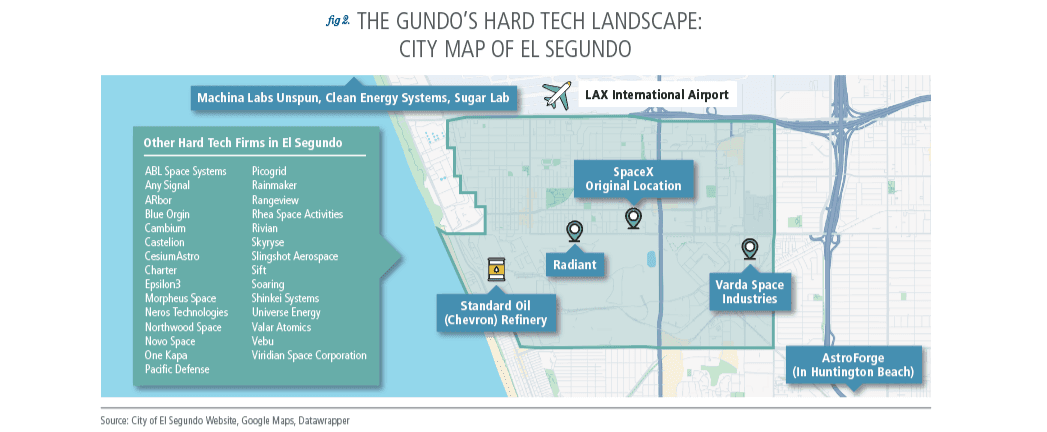
But today, the Smoky Hollow zone hosts an array of new start-ups, spurring modern light-industrial research facilities between the old office buildings and manufacturing sites.8 As of 2024, 32 “hard tech” companies called
El Segundo home, the most in any area of Los Angeles County (see Figure 2).
The SpaceX Flywheel
SpaceX’s first location was 1310 East Grand Avenue, El Segundo, where a seafood distributor now stands. Although not the first within the Gundo’s rich “hard tech” history, SpaceX’s flywheel is spinning.
Former SpaceX employees starting new companies are enabled, at least partly, by the massive drop in cost-to-orbit (see Orbital Mechanics in Vol. 2, 2023) plus the cultural affinity to build stuff and experiment with rapid iteration (which many former employees attribute to Musk’s influence).
Once you reach space, then what? According to these entrepreneurs, anything imaginable.
For example, six blocks east of SpaceX’s original headquarters stands Varda Space Industries, a start-up company dedicated to manufacturing products in space and sending them back to Earth in reusable capsules.9 Of course, it is not because the U.S. is running out of space for factories. The current and possibly next generations of high-precision products, such as semiconductors, drugs, and rocket parts, can be manufactured to be higher performing in microgravity (see Did You Know? Box: Space-Shoring). With lower “transportation costs,” building factories in space is finally no longer science fiction.
Just south of El Segundo along Interstate 405, a group of engineers at AstroForge is investigating ways to conduct mining of unique minerals in space. Clean Energy Systems, to the east along the California 91 highway, are developing projects to produce negative carbon fuels for rockets. During the journey to space, these low-carbon fuels would capture extra CO2 in the air.10
The “Silicon Valley” of Deep Tech
In addition, the manufacturing flywheel is spinning into other frontier industries, suggesting a new manufacturing renaissance might be underway.
Take a walk three blocks north of the old SpaceX site, and you will see Radiant Nuclear, a company started by a previous SpaceX engineer that produces portable nuclear-powered microreactors (Kaleidos) to replace diesel engines—the most commonly used electricity generators in industrial production, transportation, telecommunication, and hospitals. The idea of generating electricity anywhere without needing water or carbon—from the ocean floor to the top of a mountain and eventually in space—inspired the product. With the end of their testing cycle nearing, Radiant could begin delivering the world's smallest nuclear reactors as soon as 2025.11
Efficient and cost-reducing designs from SpaceX have also seeped into the metal-shaping sector—one of the manufacturing industry’s hidden pillars. As its name suggests, metal shaping bends and molds metal sheets into parts for cars, aircraft, and rockets. It sounds simple, but metal shaping requires extreme precision and large manufacturing spaces. Until now, metal shaping factories have only specialized in producing sheets for a specific product.
Machina Labs, a company founded by another former SpaceX engineer, aims to use artificial intelligence (AI) and robotic systems for efficient metal shaping. Their robotic arms can be programmed to form any type of metal sheet using immense levels of precision and just a tiny square of space.12 Imagine a small factory simultaneously producing parts for cars, planes, and rockets. Our economics textbooks should rewrite the specialization and economies of scale chapter and update it for the AI version.
An example closer to our everyday lives is 3-D printing, which is being tested to make clothes (3-D weaving at Unspun) or fancy candies (Sugar Lab). A tangible AI productivity boom has also been underway for those who still think AI is just ChatGPT.
The U.S. Manufacturing Renaissance
Lest you think this article is a simple ode to El Segundo, it is more an illustration of what has always made America great.
Manufacturing is picking up. U.S. manufacturing gauges, such as the Purchasing Managers’ Index (PMI), turned positive in the first quarter of 2024 after contracting for 17 consecutive months. Total industrial output for final products, intermediate goods, and raw materials recorded gains in May.
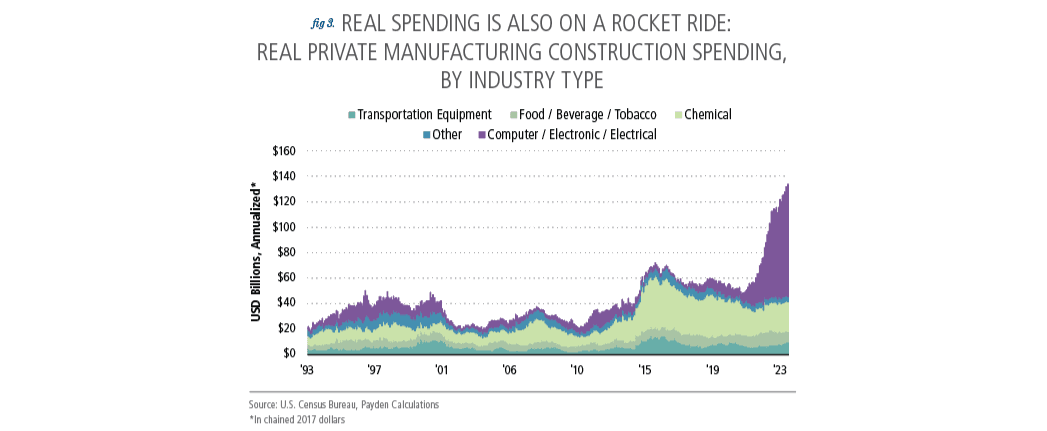
Real investment in manufacturing is also surging. U.S. non-residential fixed investment has grown the most since Covid-19 among developed country peers. In addition, private spending in manufacturing structures, especially “hard tech” related buildings, continues to record historical highs. As an indicator of investor interest, private expenditure in manufacturing has more than quadrupled since March of 2023 (see Figure 3).
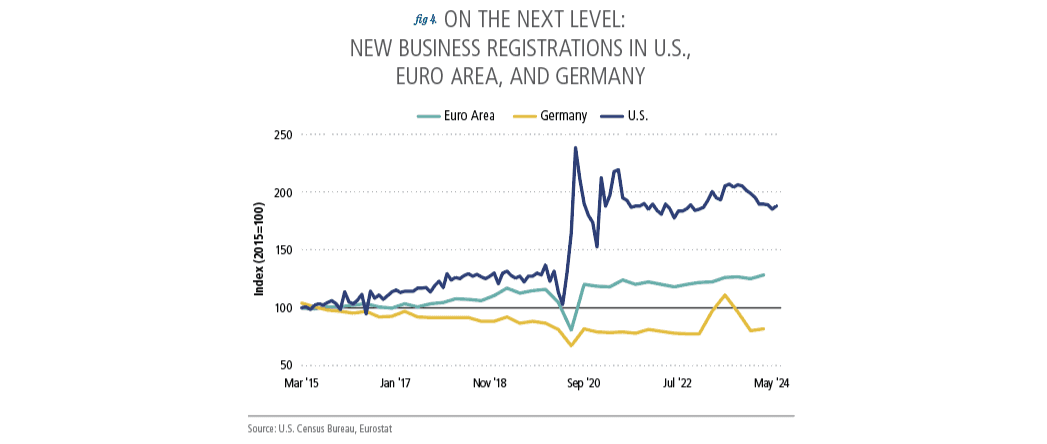
Start-ups are also picking up, not only in the new “hard tech” manufacturing space. Since 2017, new business applications in the U.S. have outpaced other developing countries (see Figure 4)—a rare case for developed countries with higher concentrations of mature firms.
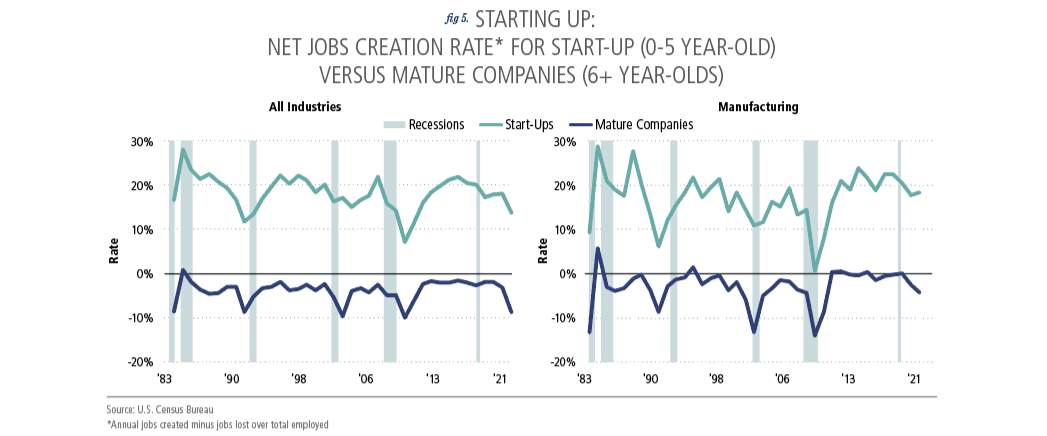
What do start-ups bring? A productivity boost and additional jobs. According to U.S. Census Bureau research, start-ups create new jobs much more rapidly than mature companies or new branches of mature companies. Net job creation rates (new jobs created minus existing jobs destroyed) hover near 20% for start-ups, especially for the manufacturing and information sector, while the net job creation rate for mature companies struggles near zero (see Figure 5).13 If you want economic growth, you must have new companies.
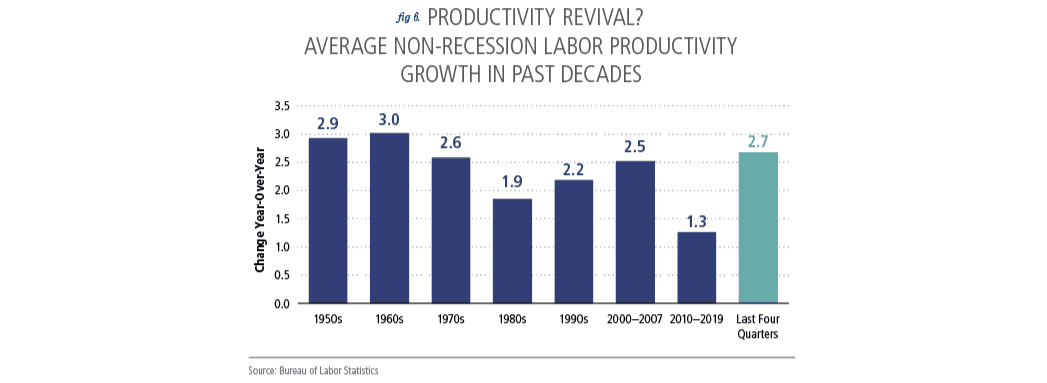
What’s more, after slumping in the 2010s, labor productivity has peaked in the last four quarters, catching up to the productivity levels of the previous internet boom (late 1990s and early 2000s, see Figure 6).
Many countries pine for a “Silicon Valley-like ecosystem,” but few, if any, have been able to replicate it.
Now, America might become home to another start-up scene, which could bode well for future growth. Everything started here in El Segundo, and it will continue.
We’re bullish on The Gundo—and America.
Did You Know?
Space-Shoring
What makes manufacturing different in space than on Earth? Gravity. A microgravity environment is helpful for crystallization. Take the example of manufacturing protein-based drugs, widely used to treat cancer, diabetes, and other immune diseases. For the last decade, many drug manufacturers have been outsourcing the protein crystallization process of their drugs to space, resulting in improved performance.18 Silicon crystallization, widely used in manufacturing semiconductors (yes, the recent investor favorites!), can also be done more effectively, faster, and cheaper when manufactured in microgravity.19 Imagine if research and development could be outsourced to space, too. It could yield new drugs and technology products for humanity.
Endnotes
Ohanian, L., Vranich, J. (2022, September). Why Company Headquarters Are Leaving California in Unprecedented Numbers. (Working Paper No. 21117). https://www.hoover.org/research/why-company-headquarters-are-leaving-california-unprecedented-numbers
U.S. Bureau of Labor Statistics, Unemployment Rate in California [CAUR], retrieved from FRED, Federal Reserve Bank of St. Louis; https://fred.stlouisfed.org/series/CAUR, July 24, 2024.
U.S. Census Bureau, Quickfacts, El Segundo City, California. https://www.census.gov/quickfacts/fact/map/elsegundocitycalifornia/RHI725222
Chevron announced on August 2, 2024, that it will move its refining facilities to Texas due to unfavorable environmental policies in California after calling El Segundo home for over 140 years!
Aerospace: The industry that built the South Bay. Easy Reader News. (2013, October 31). https://easyreadernews.com/aerospace-chronicles-industry-built-south-bay/
Ibid
Blackburn, G. A. (2009). Downey’s aerospace history, 1947-1999. Arcadia Publishing.
Madler, M. (2024, May 17). Smoky Hollow High. Los Angeles Business Journal. https://labusinessjournal.com/featured/smoky-hollow-high/
Space born, Earthbound • varda space industries. Varda Space Industries. (n.d.). https://www.varda.com/
Lindquist, J. (Ed.). (2022, January 27). Space oddity - how rocket technology could help power the energy transition. RBN Energy. https://rbnenergy.com/space-oddity-how-rocket-technology-could-one-day-help-power-the-energy-transition
Carman, J. (2024, June 17). The future of nuclear = small, mobile, microreactors | radiant. YouTube. https://www.youtube.com/watch?v=LTgS7tOOzsE
Carman, J. (2024, June 23). New Robotic System to Displace a $280B Industry. YouTube. https://www.youtube.com/watch?v=EDAR2GhlHGs&t=30s
Goetz, C., & Stinson, M. (2022). Business Dynamics Statistics Trace Evolution of Job Growth, Employment at U.S. Firms Over Four Decades. Retrieved from https://www.census.gov/library/stories/2022/02/united-states-startups-create-jobs-at-higher-rates-older-large-firms-employ-most-workers.html.
U.S. Bureau of Economic Analysis, Gross Domestic Products; International Monetary Fund World Economic Outlook Database, 2023 Gross Domestic Products In Current Dollars
National Venture Capital Association (NVCA). Q2 2024 Pitchbook.
Wine Institute. California & U.S. Wine Sales. https://wineinstitute.org/our-industry/statistics/california-us-wine-sales/
About. Mojave Air & Space Port. https://www.mojaveairport.com/about1.html
Langreth, R. (2023, December 5). Pharmaceutical companies inch closer to drugs made in space. Bloomberg.com. https://www.bloomberg.com/news/newsletters/2023-12-05/pharmaceutical-companies-inch-closer-to-drugs-made-in-space
Frick, J., Kulu, E., Rodrigue, G., Hill, C., & Senesky, D. G. (2023, November 8). Semiconductor Manufacturing in Low-Earth Orbit for Terrestrial Use. https://doi.org/10.31219/osf.io/d6ar4
This material reflects the firm’s current opinion and is subject to change without notice. Sources for the material contained herein are deemed reliable but cannot be guaranteed. This material is for illustrative purposes only and does not constitute investment advice or an offer to sell or buy any security. Past performance is no guarantee of future results. Point of View articles may not be reprinted without permission. We welcome your comments and feedback at editor@payden.com.
This material has been approved by Payden & Rygel Global Limited which is authorised and regulated by the Financial Conduct Authority. This material has been approved by Payden Global SIM S.p.A.. which is authorised and regulated by CONSOB.
Payden's expert insights delivered to your inbox
Sign up for updates, including the Week in Review and Payden & Rygel Point of View.
By clicking “Sign Up”, you agree to the relevant privacy policy for your location and consent to receive updates.