Each morning, several members of the Payden team take a break from markets and walk to our favorite neighborhood coffee house. (A shout out to Blue Bottle Coffee in the world-famous Bradbury Building. Have you ever seen Bladerunner?).
On the way back, we usually have two options: walking back up Bunker Hill or riding on the famed Angel’s Flight cable car (a tourist draw with a spotty safety record).1
But on this fall day in Los Angeles, with temps nearing 90 degrees (32 degrees Celsius for our non-American friends), we spotted a third option: Waymo’s fully autonomous vehicle (AV).
Flagging down the vehicle was easy. As with any ride-sharing app, you use your smartphone to enter pick-up and drop-off locations.
The car will display your initials on the top to identify your vehicle quickly.
The first thing you notice—which will become integral to the story—is how many whizzbangs, thingamajigs, whatchamacallits, gadgets, and gizmos adorn the vehicle (See Image 1).
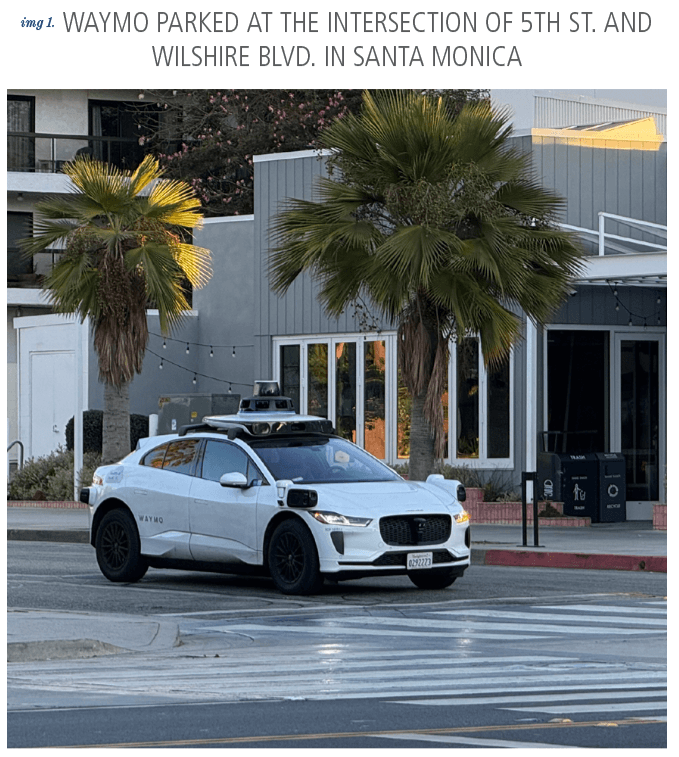
To be blunt, it looks more like a high school science project than a sleek driving machine.
Its price tag is no science experiment, though. In 2021, the then-CEO of Waymo, John Krafcik, remarked in an interview that the cost of a Waymo was no more than a “moderately equipped Mercedes S-Class,”2 which is roughly $150,000.3
After giving the vehicle’s exterior a once over, we tapped the app to unlock its doors. As we hopped in, the car greeted us with a screen that displayed our names and a welcome message.
We buckled our seatbelts and hit the “start” button on the screen. With a turn of the wheel, the vehicle pulled away from the curb, although nobody—at least no human—was guiding it.
Pathos, Ethos, and Logos
The ride was smooth, and the car handled downtown LA’s many traffic pitfalls admirably. It adeptly maneuvered through road construction and easily handled smooth braking, lane changes, navigation, and avoiding obstacles (humans and parked cars).
As we rode, we pondered how the experience of driverless vehicles appeals to riders with pathos (emotion), ethos (reputation), and logos (logic).
We all agreed that autonomous vehicles increase riders' sense of safety and comfort. Indeed, as riders of other forms of transportation—taxi, Uber, or Lyft—we must give a healthy dose of trust to a stranger in the driver’s seat.
The implication of AVs is more significant than one might think. Tisha Janigan, the head of an LA-based nonprofit organization supporting single mothers, shares our view. She advocates for driverless technology because it “could be a game-changer for women we serve, offering a nonjudgmental, reliable transportation option that prioritizes safety,” and is poised to improve equity in the transportation space.4
But rest assured, for those who are afraid of being entirely left alone with a “robot”: At the start of our ride, Waymo informed us that their cars are equipped with microphones so the rider could communicate with a (presumably human) operator when needed.
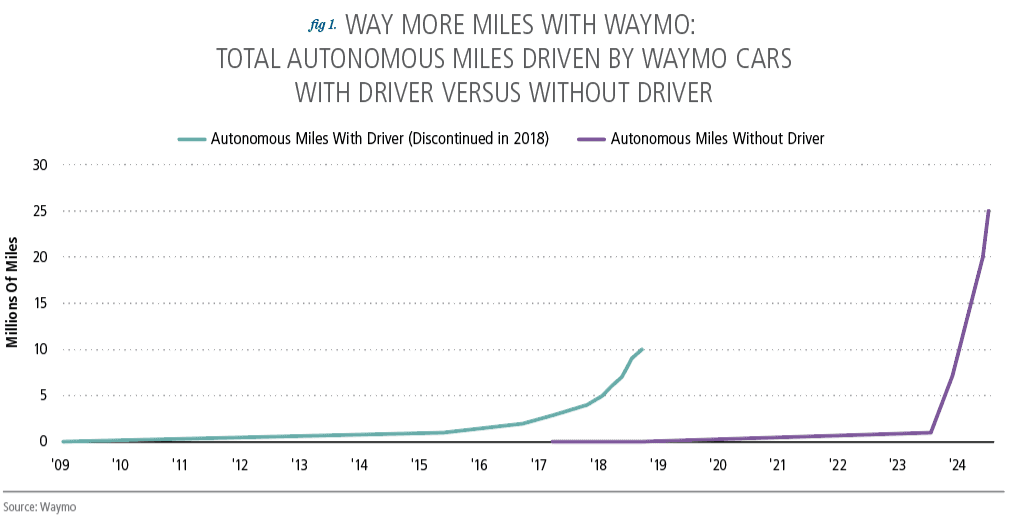
It could also be the impressive ethos that Waymo has built for itself after driving over 25 million autonomous miles without a driver (See Figure 1). Waymo’s reputation boasts a remarkable 81% fewer airbag-deploying crashes, 72% fewer injury-causing crashes, and 57% fewer police-reported crashes than an average human driver in San Francisco and Phoenix.5
Logically, we know the vehicle can see much more than any human possibly could. “The lidar suite creates a high-resolution, 360-degree field of view with a range of approximately 1,000 feet.”6 In addition to seeing everything, the car can react to any situation nearly instantly, certainly faster than a human.
Whether it was pathos, ethos, or logos, we found our time in the Waymo more pleasant than any human-driven car.
Two Technological Forks?
Some readers may shout, "Well, my Tesla already accomplishes such self-driving tasks!" To such readers, we would reply, "Well, first, congratulations on your purchase. And, yes, but you are safely behind the wheel, ready to assume control at a moment’s notice should the autopilot disengage." Not so in the Waymo vehicle.
How do the two approaches differ (Waymo versus Tesla)?
Based on our first-hand account as riders, Waymo seems more meticulously equipped (hence all the gadgets on the vehicle). Waymo's fifth-generation sensor suite “has no fewer than 13 sensors, including a 360-degree lidar, three perimeter lidars, three radars, and a bunch of video cameras.”7
Tesla, meanwhile, doubled down on camera/video guidance systems to detect obstacles while driving, citing lidars as “expensive sensors that are unnecessary.”8 Interestingly, though, Teslas with lidar racks have been spotted as recently as October 2024.9
Aside from the cost, relying solely on cameras has clear downsides. Compared to cameras, lidar systems “see” better than any human eye or camera could in severe weather conditions. Cameras also get blocked more easily—a risk autonomous vehicles cannot afford to operate with.
Waymo’s approach also has geographical limitations, as the system doesn’t offer driverless rides outside its pre-mapped areas. But rest assured, Tesla has yet to offer any driverless rides and requires human intervention every 13 miles on average.10
However, Tesla and Waymo might converge toward the same path with AI technology. In fact, both systems have recently shifted to neural net machine intelligence (a type of AI) to navigate.
Tesla publicly claims that AI will solve all its camera problems. To achieve this, Tesla is developing the world’s most powerful AI training cluster in Texas, which will utilize more than 100,000 Nvidia GPUs.11
One must also remember that Alphabet, Google's parent company, owns Waymo. Powered by Google’s very own large language model (LLM), Gemini, Waymo has created an End-to-End Multimodal Model for Autonomous Driving called EMMA.12
Ultimately, both technological forks might lead to the same path. Waymo and Tesla have discovered that AI and lidar are needed to make their autonomous visions more than a dream.
Winner Takes All?
It may not matter which method wins out. Let’s assume that one day, millions of autonomous vehicles are zipping around Los Angeles (and every other city in the world). Our brief journey suggests we’re close to such a future. How will things change?
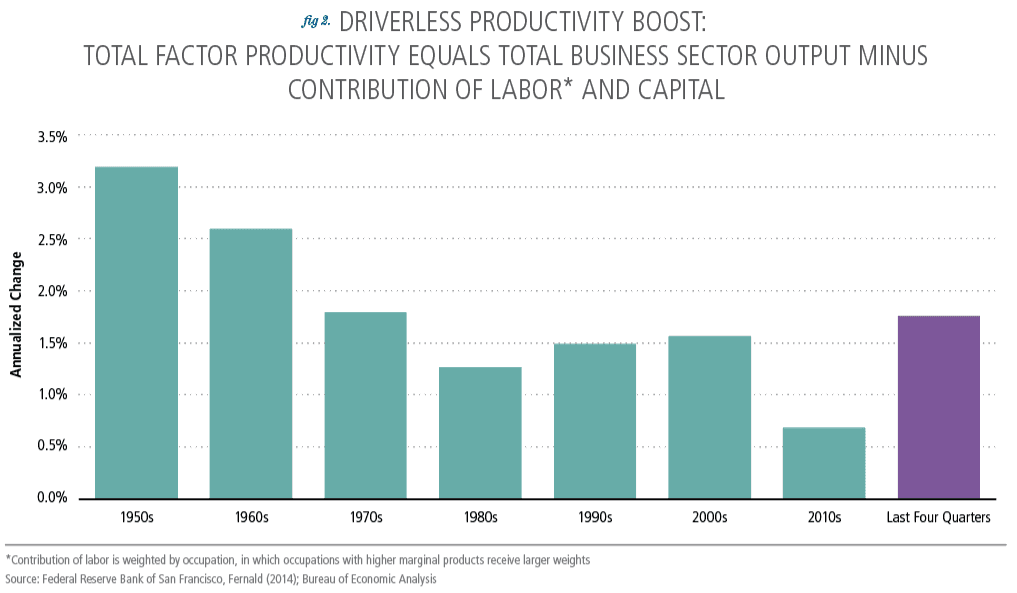
First, the average American who commutes to work spends 27 minutes alone en route, which amounts to nearly an hour of the day wasted on commuting.13 With AVs, people will arrive at work without the pain of morning traffic jams, leading to less fatigue and more work accomplished along the way, which may further boost productivity (see Figure 2).
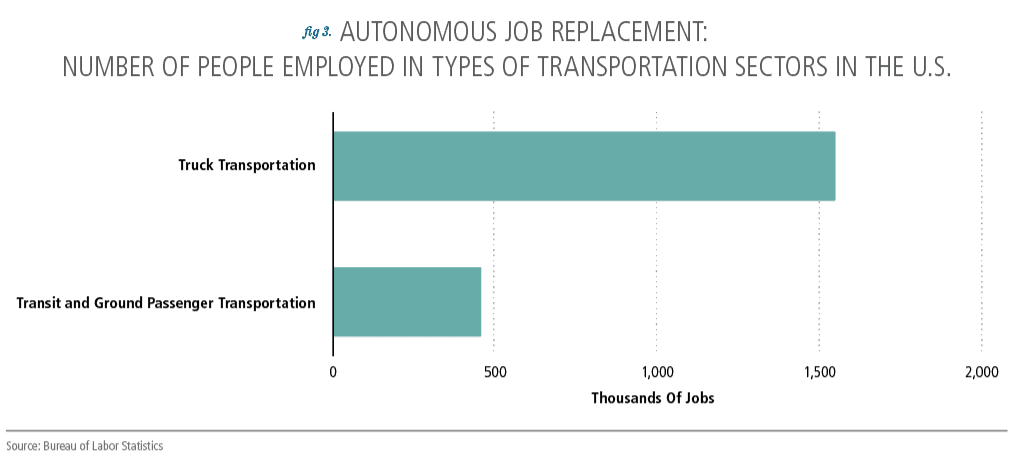
Unlike Uber, Lyft, or taxi services, Waymo does not need to pay drivers, which has enormous implications for freight and passenger transport employment (see Figure 3). So, once the vehicle's initial cost is covered, these cars will generate nearly pure profit.
A study of a Waymo in San Francisco calculated the average fare at $11.84 per mile for 70 rides.14 Assuming a conservative total mileage for the cars that Waymo uses is 100,000 miles, a single Waymo will produce over a million dollars of revenue, far outweighing the cost of the vehicle itself.
In 2023, Uber generated $138 billion in gross bookings, yet due to driver costs, it could only retain a quarter of that as revenue.15 A Waymo business model could capture the remaining three-quarters of gross bookings as revenue.
The Future Is Hard To Predict
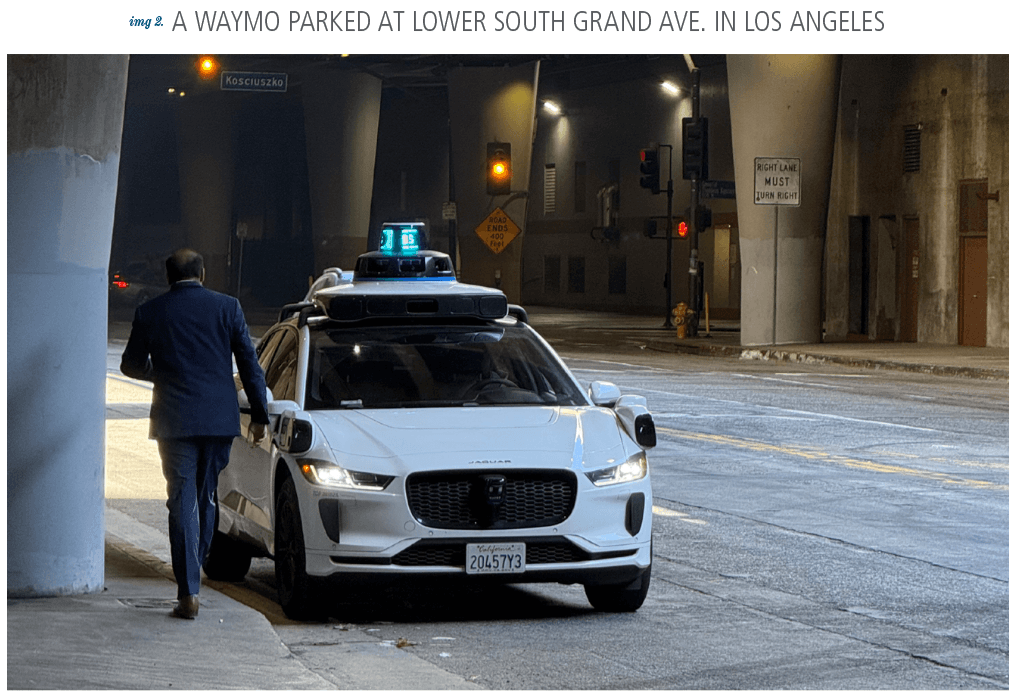
Ultimately, and hilariously, our Waymo dropped us at the wrong destination. Well, the correct GPS coordinates, but downtown Los Angeles is difficult as there is an upper and lower Grand Avenue, the street on which P&R’s home base sits. The Waymo dropped us at Lower Grand, a mistake also made by too many Uber drivers to count (see Image 2).
We have learned that seeing the future takes time, even with the best intuition in the present.
Endnotes
Is Angels Flight inherently dangerous? (2013, September 17). Los Angeles Downtown News - the Voice of Downtown Los Angeles. https://www.ladowntownnews.com/opinion/is-angels-flight-inherently-dangerous/article_381e192e-1cca-11e3-a21e-0019bb2963f4.html
Moreno, J. (2021, January 22). Waymo CEO Says Tesla Is Not A Competitor, Gives Estimated Cost Of Autonomous Vehicles. Forbes. https://www.forbes.com/sites/johanmoreno/2021/01/22/waymo-ceo-says-tesla-is-not-a-competitor-gives-estimated-cost-of-autonomous-vehicles/
Mercedes Benz. (2024, November 13). Vehicle Inventory Locator. Mercedes Benz. https://www.mbusa.com/en/vehicles/inventory
The Waymo Team. (2024, November 12). Waymo One is now open to all in Los Angeles. Waypoint. https://waymo.com/blog/2024/11/waymo-one-open-to-all-in-los-angeles
The Waymo Team. (2024, July 31). Safety Impact [Dashboard]. Waymo. https://waymo.com/safety/impact/
Dnistran, I. (2024, October 11). Tesla Robotaxi vs. Waymo vs. Cruise: Here’s How They Stack Up. InsideEVs. https://insideevs.com/news/736709/tesla-robotaxi-waymo-cruise/
Ibid
Ibid
Herger, M. (2024, October 23). Four Tesla Lidar Vehicles Spotted in Palo Alto [Blog]. The Last Driver License Holder... https://thelastdriverlicenseholder.com/2024/10/22/four-tesla-lidar-vehicles-spotted-in-palo-alto/
Gitlin, J. M., & Gitlin, J. M. (2024, September 25). Tesla Full Self Driving requires human intervention every 13 miles. Ars Technica. https://arstechnica.com/cars/2024/09/tesla-full-self-driving-requires-human-intervention-every-13-miles/
Kothari, S. (n.d.). Tesla’s “Cortex” Supercomputer Is What Its Robotaxi Hopes Ride On. InsideEVs. Retrieved November 6, 2024, from https://insideevs.com/news/731363/tesla-cortex-supercomputer-giga-texas/
The Waymo Team. (2024, October 30). Introducing Waymo’s Research on an End-to-End Multimodal Model for Autonomous Driving. Waypoint. https://waymo.com/blog/2024/10/introducing-emma
U.S. Census Bureau, U. C. (2023, December 31). United States Commuting At A Glance: American Community Survey 1-Year Estimates. Census.Gov. https://www.census.gov/topics/employment/commuting/guidance/acs-1yr.html
Herger, M. (2024, August 2). Costs of Waymo Rides [Blog]. The Last Driver License Holder... https://thelastdriverlicenseholder.com/2024/08/01/costs-of-waymo-rides/
Uber. (2024, February 7). Uber Announces Results for Fourth Quarter and Full Year 2023. Uber Investor. https://investor.uber.com/news-events/news/press-release-details/2024/Uber-Announces-Results-for-Fourth-Quarter-and-Full-Year-2023/default.aspx
This material reflects the firm’s current opinion and is subject to change without notice. Sources for the material contained herein are deemed reliable but cannot be guaranteed. This material is for illustrative purposes only and does not constitute investment advice or an offer to sell or buy any security. Past performance is no guarantee of future results. Point of View articles may not be reprinted without permission. We welcome your comments and feedback at editor@payden.com.
This material has been approved by Payden & Rygel Global Limited which is authorised and regulated by the Financial Conduct Authority. This material has been approved by Payden Global SIM S.p.A.. which is authorised and regulated by CONSOB.