Earlier this year, President Trump signed an executive order increasing the filing fee for an H-1B visa application for skilled foreign workers in specialty occupations, from a previous maximum of $5,000 per petition to $100,000.1
The media reaction to the higher visa fees was loud. The attention is warranted, given that, despite the H-1B program comprising less than 1% of America’s labor force, it is the most extensive high-skilled immigration program in the U.S. and the most common gateway to permanent residency through employment.
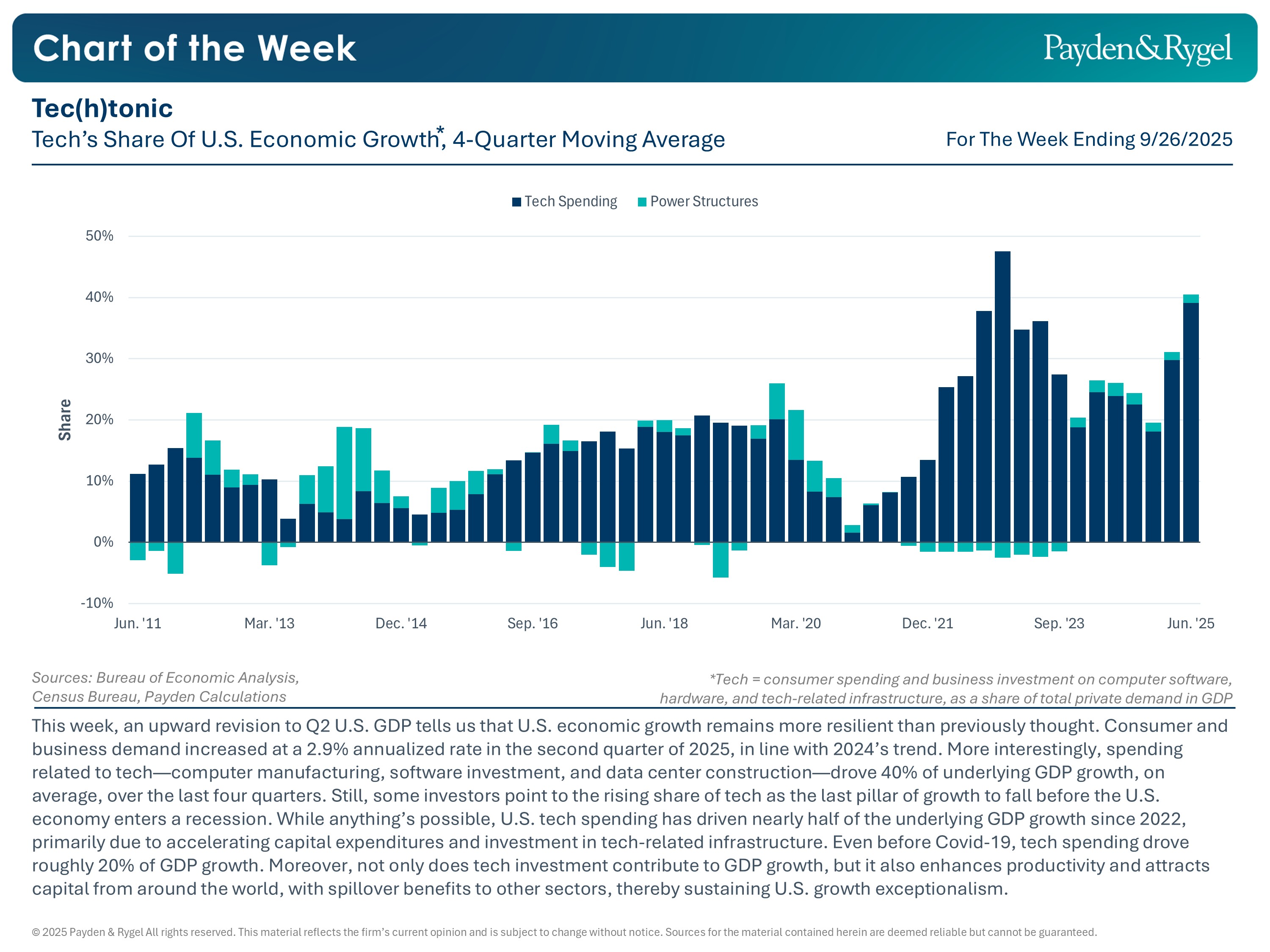
What’s more, H-1B workers primarily work in computer-related occupations (see Figure 1). Interestingly, the tech sector has also been responsible for around 40% of U.S. GDP growth in the last four quarters.2 In our view, however, the debate over higher H-1B filing fees overlooks a larger truth: the H-1B system was designed for a pre-Internet era and is no longer well-suited to today's dynamic economy.
Below, we highlight four reasons the system is outdated and suggest possible paths forward.
Fig. 1
Give Me The Computer Scientists
H-1B Petitions Approved By Major Occupation Group In 2024
Sources: U.S. Citizenship and Immigration Services (USCIS), Payden Calculations
Capped In Time
First, the H-1B visa program is literally outdated. The U.S. immigration system follows a law signed by President George H. W. Bush, the Immigration Act of 1990, well before the Internet Age.
The 1990 Immigration Act created specific employment-based visas, including the H-1B visa, designated for “specialty occupations,” and capped new H-1B visas at 65,000 annually.3
Since 1990, the U.S. labor force has added nearly 50 million workers, yet the visa cap has remained static. In 2005, Congress added just 20,000 additional slots for people with a U.S. master’s degree or higher.
Worse, the H-1B visa is often the most viable option for foreign workers to work and reside in the U.S. As a result, H-1B applications regularly exceed the available slots (see Figure 2). Since immigration to the U.S. is a key driver of labor force growth—and thus output growth—the situation is acute. Net immigration has accounted for about 41% of U.S. population growth from 2005 to 2020 and over 85% in the last four years (see Figure 3).
Fig. 2
The Scarcity Trap
Annual H-1B Applications Received By The USCIS Versus H-1B Cap
Source: U.S. Citizenship and Immigration Services (USCIS)
*Applications for fiscal year 2026 began in March 2025 and the 85k cap was filled by July 18, 2025
Fig. 3
Population Crossroads
U.S. Population Growth Contribution By Existing Population And Immigration
Source: Congressional Budget Office
And there’s another layer: immigrants also boost population growth by starting families in the U.S. As of 2024, first- and second-generation immigrants (those born native to immigrant parents) now comprise 28% of the total U.S. population, up from 20% before 2005.4
To date, robust immigration has helped the U.S. avoid an issue plaguing other G7 economies: slowing population growth. Immigration also helps prevent talented, high-skilled workers from ending up elsewhere, such as Canada, India, and China.5 But, without net immigration, the U.S. population will start to shrink by 2033—and so will potential economic output (see Figure 3 again).
Luck Over Skill
Second, the visa application process imposes unnecessary costs that disadvantage small businesses.
Firms apply for visas on behalf of foreign workers. In years when applications exceed the immigration cap (as has happened every year in the last decade), the U.S. Citizenship and Immigration Services (USCIS) uses a lottery to select visa winners.
However, in a random lottery, it is volume, not the value of the vocation or the merit, that will win.
For instance, big U.S. tech companies and large overseas IT consulting firms dominate H-1B filings because they can submit petitions on a larger scale. In fact, overseas IT consulting firms often end up winning even more slots than U.S. tech firms, despite paying lower wages, because they can submit more petitions from staff who can stay abroad if not selected.
As a result, the wasted recruitment costs for businesses seeking more workers than the visas available total $1.9 billion annually.6
Sure, bigger companies can afford visa costs and legal fees. But small businesses, which are a critical part of the economy and accounted for 55% of net job creation from 2013 to 2023, are disadvantaged in the lottery system.7
Foreign high-skilled workers have actually been proven to increase business survival rates among smaller firms, making them more likely to receive external funding, be acquired, or go public.8
In short, the lottery system creates additional visa costs that harm small businesses, restrain them from scaling, and hinder net job creation.
Visa Bound
Our third gripe with the current visa system is that winning the lottery is only the first step toward permanent residency. Long wait times, the drawbacks of temporary status, and job transfer limitations also hinder labor mobility and, consequently, economic growth.
Visa lottery winners often wait in limbo for up to a decade to receive a green card, especially for Indian and Chinese nationals, due to the annual green card quota by country set by the U.S.9
In the meantime, the temporary nature of the H-1B status means that, if a visa worker loses their job, they only have 60 days to find another job before they have to return to their country of permanent residence.
Still, even if H-1B workers retain their jobs, they are tied to a single employer while awaiting approval of their permanent residency application. Switching jobs means workers have to restart their application process and “move to the back of the line,” a waste of time that many would like to avoid.
Further, the “specialty occupation definition and criteria” of the H-1B visa also requires an H-1B worker’s job to be directly related to their degree.10 Although useful for retaining talent in high-skill jobs that often require a matching college degree, the current visa system can constrain H-1B workers to a single job directly related to their degree for over a decade, posing a significant hindrance to labor mobility.
In the short run, the impact of a more mobile workforce could be mixed, as it could lead to wasted training costs for larger firms. However, over the long run, research shows that free movement of labor can lead to increased business investments, sales growth rates, and profitability, especially during economic recoveries and expansions, making the economy more resilient to economic shocks and fostering a more dynamic business environment.11
Finally, today’s economy rewards interdisciplinary skills. For example, statisticians, computer scientists, historians, and even English majors can all make great financial market economists, at least on the Payden Economics team.
As a result, the current visa system is making the U.S. economy less efficient, inflexible, and more brittle in the face of adverse shocks.
Innovation Trap
Fourth, the visa system is outdated because it discourages innovation for foreign high-skilled workers. Given that the H-1B visa eligibility requirements prevent foreign workers from hanging up their own shingle and striking out on their own (since their status in the U.S. is tied to their employer), the program prevents risk-taking entrepreneurship, another key trait that makes the U.S. economy innovative.
After the Covid-19 recession, new business registrations spiked 74% in 2021 compared to December 2019, aiding the U.S. economy’s rapid recovery. An H-1B worker, however, would have been unable to actively start and manage their own business due to visa limitations.
Such limitations exert hidden costs on the U.S. economy.
Indeed, immigrants often punch above their weight in terms of innovation. Although immigrants make up only 11% of the U.S. population, they account for a much larger share of innovative output (see Figure 4).12
Furthermore, firms receiving more H-1B visas are also correlated with more patents and patent citations.13
Fig. 4
Productivity Punch
Immigrant Share Of U.S. Inventors And Innovative Output
Source: Bernstein et. al. (2022)
Another Path
We’ve spilled enough ink on the existing problems and economic impacts of the outdated visa system of the U.S. But, is there a better way?
First, we can lift the visa cap to alleviate the buildup and unintended delays that further exacerbate other issues. There’s a precedent for this: during the late 1990s tech boom, Bill Gates and other major tech companies lobbied Congress to raise the cap first to 115,000 in 1998 and then to 195,000 in 2000, with a sunsetting provision in 2003.
Second, global peers use a “points-based” system. For example, Canada, Australia, and the UK all use points-based systems that reward workers based on their education level, language proficiency, work experience, age, and sometimes special points for certain job occupations.
Third, New Zealand and the UK also award more points to higher-paid workers, shifting closer to a compensation-based system that assigns visas to more “valuable” workers based on their salaries. Research suggests that switching to a compensation-based visa system would have the same boost on GDP as roughly doubling the cap under the current lottery system.14
After all, the free market allocates wages based on the productivity and output that firms expect from workers. Visas could—and arguably should—do the same.
Silver Lining
The silver lining to the visa program discussion is that the “sticker shock” of a significant H-1B visa fee hike may spark interest in modernizing immigration law to keep America’s policy up to date, especially given that the current U.S. population is set to decline in the next decade without new net immigration (see Did You Know? The Aggregate Visa Landscape).
Did You Know?
The Aggregate Visa Landscape
In 2024, about 11.6 million visas were issued. But, as mentioned, the H-1B cap is 85,000. Visas are divided between immigrant visas for permanent residents with a “green card” and non-immigrant visas for temporary residents, accounting for 5% and 95% of all visas issued, respectively (see Figure 5). Within the immigrant categories, 43% are issued to immediate relatives of U.S. citizens and permanent residents, and about 34% are family-sponsored immigrants. Only 8% are issued to applicants awaiting H-1B visas and those in the immigrant investor program. Meanwhile, approximately 77% of non-immigrant visas are issued for tourists and business visitors who are not considered part of the U.S. labor force. Finally, new and existing H-1B and student visas account for 7% and 3% of non-immigrant visas, respectively. Transit or crew members (flight attendants), exchange visitors, and government or international organization officials make up most of the remaining visas issued.15 In short, H-1B workers seemingly generate more economic output and garner more media attention than their share of the overall immigration picture.
Allowing the visa cap to flow with the size of the U.S. labor force, selecting visa applicants based on their “contribution to the economy,” reducing friction that hinders labor mobility for visa workers, and allowing greater flexibility for entrepreneurship could be good starters.
At the end of the day, if one goal of U.S. immigration policy is to continue attracting global talent to fuel innovation, then ideally, some innovation in the policy's design might be needed, too (see Did You Know? The Aggregate Visa Landscape). In 2024, about 11.6 million visas were issued. But, as mentioned, the H-1B cap is 85,000. Visas are divided between immigrant visas for permanent residents with a “green card” and non-immigrant visas for temporary residents, accounting for 5% and 95% of all visas issued, respectively (see Figure 5). Within the immigrant categories, 43% are issued to immediate relatives of U.S. citizens and permanent residents, and about 34% are family-sponsored immigrants. Only 8% are issued to applicants awaiting H-1B visas and those in the immigrant investor program. Meanwhile, approximately 77% of non-immigrant visas are issued for tourists and business visitors who are not considered part of the U.S. labor force. Finally, new and existing H-1B and student visas account for 7% and 3% of non-immigrant visas, respectively. Transit or crew members (flight attendants), exchange visitors, and government or international organization officials make up most of the remaining visas issued.15 In short, H-1B workers seemingly generate more economic output and garner more media attention than their share of the overall immigration picture.
Fig. 5
The Visa Landscape
Total Visas Issued In Fiscal Year 2024
Endnotes
Subsequent clarification narrowed who would be subject to the new H-1B fees to only foreign-based petitions. In other words, any “change of status” request from another non-immigrant visa (such as a student visa) to an H-1B would not be subject to the fees. Renewals and amendments of H-1B visas that were approved before September 21, 2025, are also exempt from the fee hike.
Based on the Bureau of Labor Statistics (BLS) average median weekly earnings and Payden calculations of the contribution by the tech sector to GDP growth from Q2 2024 to Q2 2025.
The precursor to the H-1B visa was the H-1 visa created by the 1965 Immigration and Nationality Act (INA), which established temporary employment for workers with “distinguished merit and ability” who maintained a residence abroad. The 1990 act raised the annual immigration limit from 270,000 in 1965 to 675,000 and created specific employment-based paths to a green card. It also split the non-immigrant H-1 visa into H-1A for nurses and H-1B for “specialty occupations.”
U.S. Census Bureau. (2024, March 22). Foreign-born data tables. https://www.census.gov/topics/population/foreign-born/data/tables.html
Glennon, B. (2023). How do restrictions on high-skilled immigration affect offshoring? Evidence from the H-1B Program. Management Science, 70(2), 907-930. https://doi.org/10.1287/mnsc.2023.4715
Neufeld, J. (2025, January). Talent recruitment roulette: Replacing the H-1B lottery. Institute for Progress. https://ifp.org/h1b/
U.S. Bureau of Labor Statistics. (2024, May 1). Small businesses contributed 55 percent of the total net job creation from 2013 to 2023 [The Economics Daily]. https://www.bls.gov/opub/ted/2024/small-businesses-contributed-55-percent-of-the-total-net-job-creation-from-2013-to-2023.htm
Morales, N. (2025, October). Understanding the potential impact of H-1B visa program changes (Economic Brief No. 25-39). Federal Reserve Bank of Richmond. https://www.richmondfed.org/publications/research/economic_brief/2025/eb_25-39; Dimmock, S. G., Huang, J., & Weisbenner, S. J. (2019). Give me your tired, your poor, your high-skilled labor: H-1B lottery outcomes and entrepreneurial success (NBER Working Paper No. 26392). National Bureau of Economic Research. https://doi.org/10.3386/w26392
While there is no limit on the country of origin for the H-1B visa, the Immigration and Nationality Act states that each country’s employment-based green cards cannot exceed 7% of total green cards per year. Since Chinese and Indian nationals comprise a significant portion of H-1B workers, their demand for green cards consistently exceeds the 7% cap, resulting in lengthy backlogs.
Department of Homeland Security. (Latest amendment 9/05/2025). 8 CFR § 214.2: Special requirements for admission, extension, and maintenance of status. Electronic Code of Federal Regulations. https://www.ecfr.gov/current/title-8/part-214/section-214.2
Bai, J., Eldemire, A., & Serfling, M. (2024, May 23). The effect of labor mobility on corporate investment and performance over the business cycle. Journal of Banking and Finance, forthcoming. https://doi.org/10.2139/ssrn.3721708
Dimmock, S. G., Huang, J., & Weisbenner, S. J. (2019).
Ibid.
Neufeld, J. (2025, January).15. U.S. Department of State, Bureau of Consular Affairs. (2024). 2024 annual report: Statistics of U.S. visas [Tables I & XV(A)]. https://travel.state.gov/content/travel/en/legal/visa-law0/visa-statistics/annual-reports/report-of-the-visa-office-2024.html
This material reflects the firm’s current opinion and is subject to change without notice. Sources for the material contained herein are deemed reliable but cannot be guaranteed. This material is for illustrative purposes only and does not constitute investment advice or an offer to sell or buy any security. Past performance is no guarantee of future results. Point of View articles may not be reprinted without permission. We welcome your comments and feedback at editor@payden.com.
This material has been approved by Payden & Rygel Global Limited which is authorised and regulated by the Financial Conduct Authority. This material has been approved by Payden Global SIM S.p.A.. which is authorised and regulated by CONSOB.