Rates Ruckus
Week Ending: March 20, 2026
Rates Ruckus
Market Expectations Of Total Policy Rate Changes in 2026
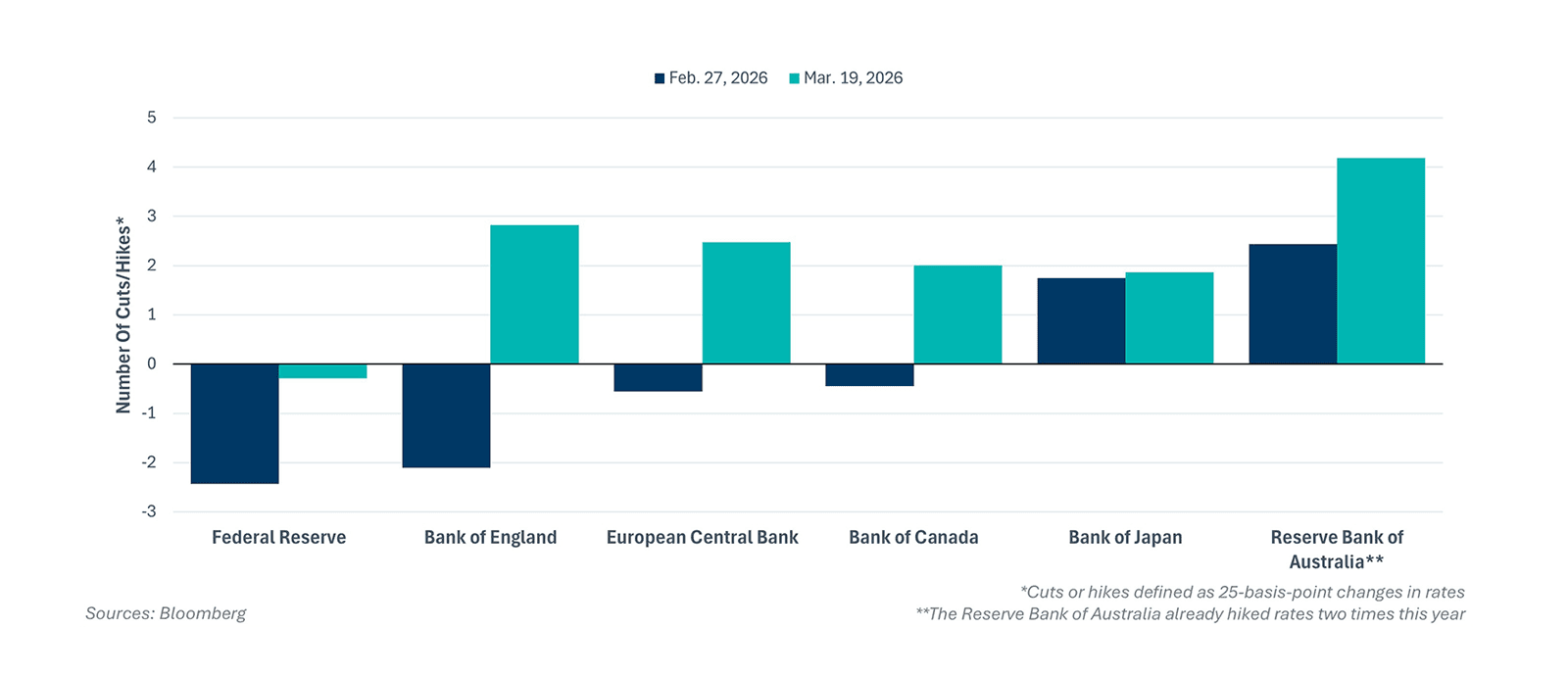
During a week with a flurry of central bank meetings and surging energy prices, investors dramatically repriced expectations for global monetary policy. Bond investors shifted from expecting two rate cuts this year in the U.S. to almost none, and from two rate cuts to two rate hikes in the U.K. But is the rapid repricing justified? Well, with the 2022 oil price spike and the subsequent surge in inflation still fresh in the mind, it makes sense that policymakers are worried that household inflation expectations could become unanchored after a series of shocks and five years of above-target inflation. However, we doubt 2026 will be a repeat of 2022, as global economies are on a completely different footing today. When oil prices spiked in 2022, global labor markets were very tight, goods prices had already surged following the largest supply shock in decades, and government transfers were massive. Today, in contrast, major economies are collectively shedding jobs on average, particularly in the U.S. and the U.K., which could dampen the pass-through of higher energy prices into inflation and worsen the drag on growth. Perhaps a jolt to global bond markets presents opportunities for discerning investors who have a different view from what’s priced in.
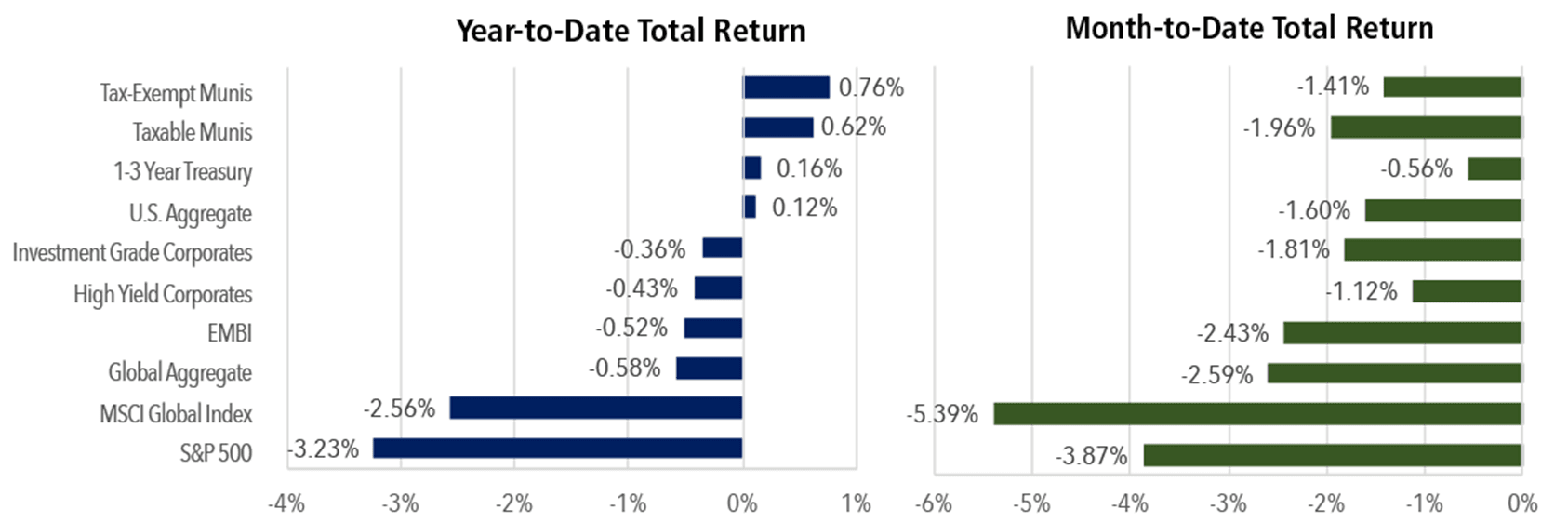
Total Returns by Asset Class
Highlights of the Week:
High Yield: High yield (HY) bond yields have increased by 84 basis points since the lows of January 2026 and, at 7.3%, are now the highest they've been since the first half of 2025, when the market was assessing the impact of tariffs on the global economy. Since the starting yield is the best predictor of long-term returns for HY bonds, this could present an interesting entry point for long-term investors.
Corporates: Just $34 billion of investment-grade (IG) corporate primary supply came to market this week, with many issuers staying back due to the Federal Reserve meeting and escalation in the Middle East. Although interest rates surged higher this week, IG spreads actually narrowed by 4 basis points (bps) to an option-adjusted spread of 88 bps as of Thursday’s close.
Municipals: For the week ending March 18, 2026, LSEG Lipper reported $1.8 billion of inflows into municipal funds (driven by strong ETF demand despite open-end outflows), marking the 17th consecutive week of inflows, while year-to-date inflows total approximately $25 billion, the third-highest pace on record.
Equities: The U.S. equity market ended the week lower amid geopolitical tensions, rising oil prices, and a more hawkish interest-rate outlook, dampening investor sentiment. Most sectors declined, with consumer staples, materials, and real estate the worst performers, while energy, financials, and technology fared better.
Securitized Products: In the European collateralized loan obligation (CLO) market, ongoing geopolitical tensions and rising oil prices continue to impact investor sentiment. Meanwhile, AI-driven disruption in the software sector, which accounts for 9% of the European leveraged loan market, is prompting closer examination of the sector’s long-term credit fundamentals. In this environment, a split is forming: higher-quality collateral is seeing stronger demand, while weaker loan pools are under more pressure and experiencing sharper price drops.
Disclosure: This material reflects the firm’s current opinion and is subject to change without notice. Sources for the material contained herein are deemed reliable but cannot be guaranteed.