Transit Trouble
Week Ending: March 06, 2026
Transit Trouble
Daily Transits Of Tankers And Gas Carriers Through The Strait
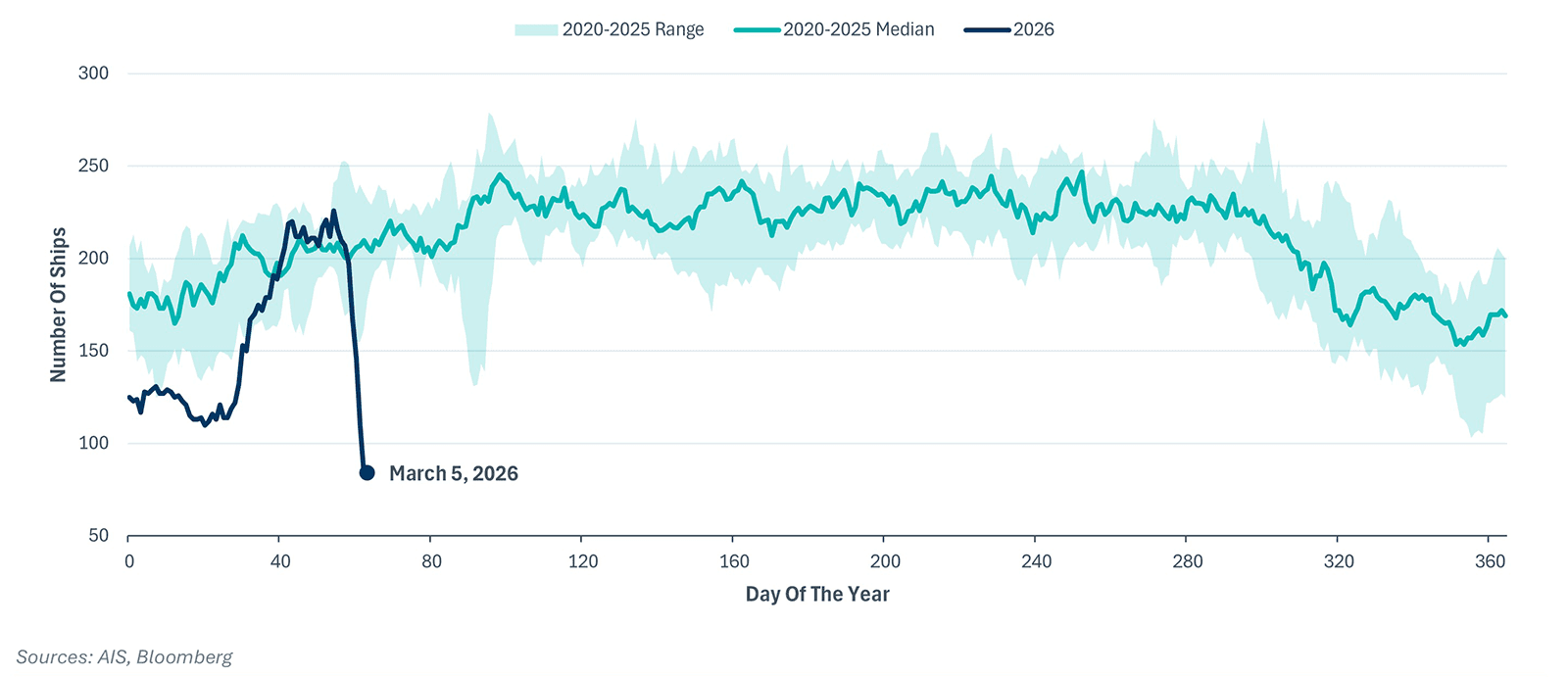
For financial markets, the most pressing issue arising from events in the Middle East is the flow (or disruption) of energy through the narrow Strait of Hormuz. In the week before hostilities erupted, roughly 735 commercial vessels, including 210 tankers and gas carriers, transited the Strait. In the five days since the war began, ship traffic slowed to its lowest since 2020. Over 150 tankers are waiting outside the Strait, a container ship has already been hit, and two others have turned around. It’s little surprise that the price of Brent oil has spiked 17% as of Thursday’s close, and European benchmark gas futures surged 59% after attacks on Qatari LNG facilities forced a production suspension. The ultimate macro impact will depend on the duration of the disruption. Days or weeks versus months and quarters? Our main view is that the longer the energy supply flow is restricted, the bigger the risk to global economic growth, rather than inflation. In particular, Asia and Europe would be more exposed than the U.S., which receives only about 2% of energy shipments through the Strait.
Total Returns by Asset Class
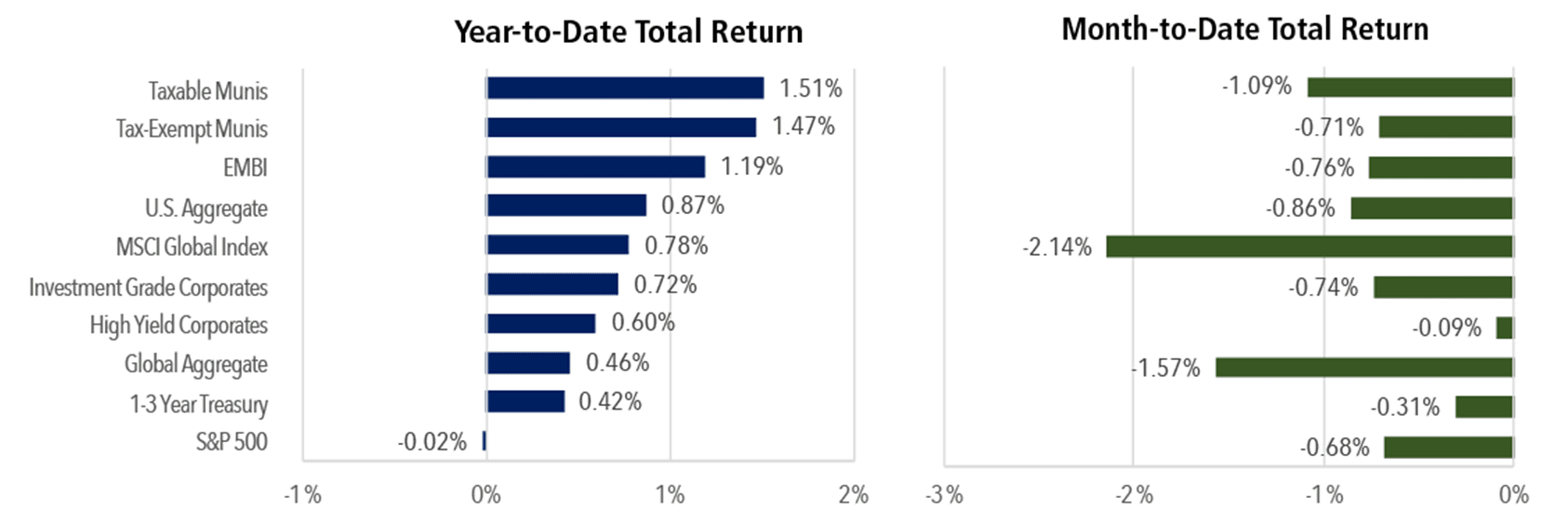
Highlights of the Week:
High Yield: High yield has traditionally safeguarded capital during risk market sell-offs, and this week was no different. The S&P 500 dropped 0.64% through Thursday’s close, while the high yield market declined just 0.04%. High yield remains an important part of a diversified portfolio.
Corporates: Issuers are looking for signs of improving market sentiment to re-enter the new issue market. Only one deal was priced on Monday and Tuesday, before more than $50 billion came to market across 25 issuers over the next two days. Due to the volatility, deal performance has been mixed, but spreads on newly issued bonds have tightened on the margin in the secondary market.
Municipals: Strong fund inflows combined with robust reinvestment demand this year have helped the municipal bond market absorb high supply and maintain healthy performance.
Equities: In a volatile week of trading, the U.S. equity market posted negative returns, largely due to escalating geopolitical tensions. Almost all sectors finished in negative territory, with materials, consumer staples, and healthcare as the worst performers, while energy, technology, and consumer discretionary demonstrated some resilience.
Securitized Products: Prepayment speeds predictably rose in February as mortgage rates reached their lowest point since 2022. Borrowers showed greater responsiveness to refinance opportunities, likely driven by media coverage of mortgage rates falling below 6% and the announcement of a government-sponsored enterprise (GSE) mortgage-backed security (MBS) buying program. Specified pools focusing on Florida, low loan balances, and low FICO scores exhibit better convexity than generic pools.
Disclosure: This material reflects the firm’s current opinion and is subject to change without notice. Sources for the material contained herein are deemed reliable but cannot be guaranteed.