Supply Shuffle
Week Ending: February 20, 2026
Supply Shuffle
U.S. Annual Trade Balance Compared To The Change In Import Composition
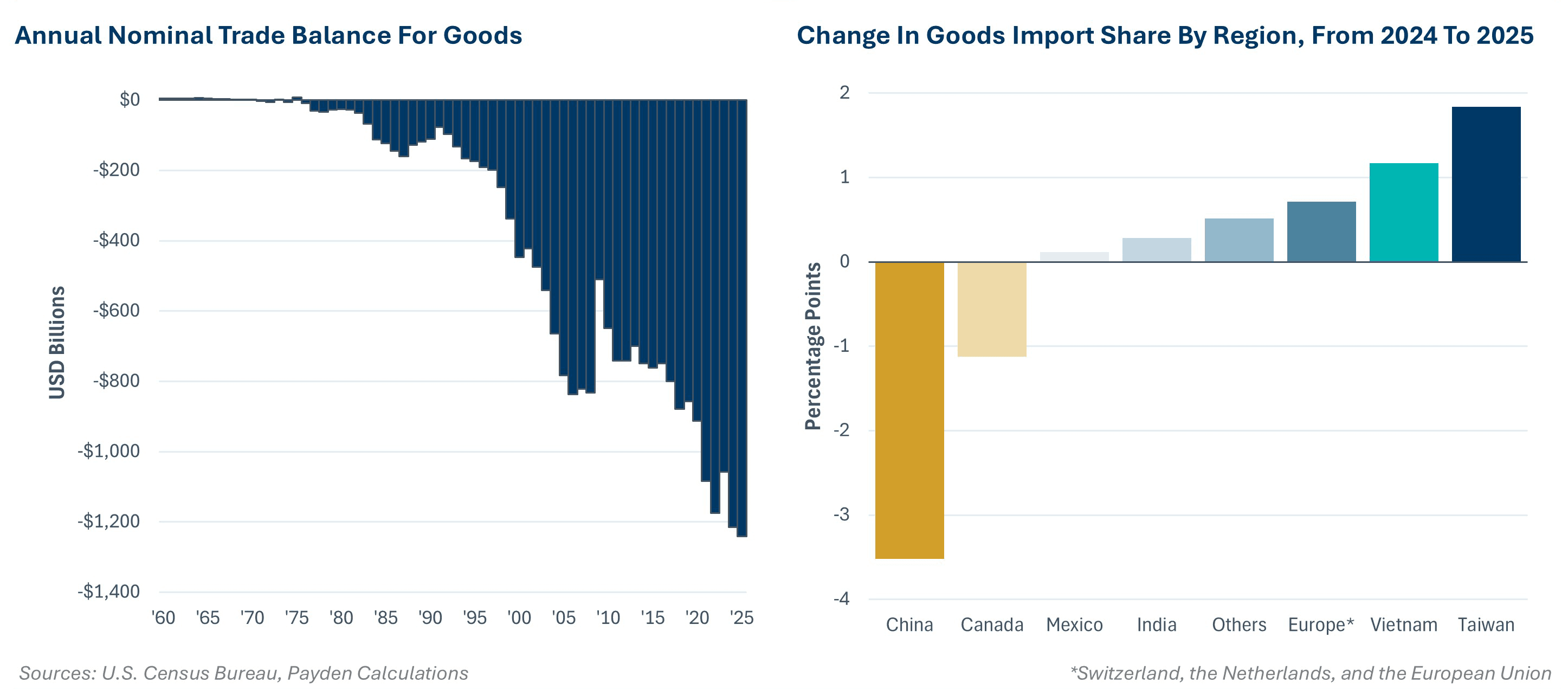
Data released this week show that the U.S. nominal goods trade deficit widened to -$1.2 trillion, the largest on record since 1960 — despite the sharpest increase in tariff rates in decades, which were intended to narrow the gap. How so? Supply chains shuffled as importers exploited tariff rate differentials across countries. U.S. imports shifted away from higher-tariff countries such as China and Canada to countries with lower average tariff rates. With the effective tariff rate on China rising to 40%, U.S. imports of goods from China fell by 30% in 2025 compared to 2024. Meanwhile, Switzerland, Vietnam, and Taiwan saw the largest increases in their shares of U.S. imports. As a result, while the average tariff rate was forecasted to be near 30% in April 2025, the actual effective tariff rate, which accounted for supply chain shifts and ongoing negotiations, was only 10% as of November 2025. It turns out, global trade was much more resilient than investors initially thought. And, despite fears of deglobalization in 2025, tariff implementation diversified global trade and perhaps made supply chains more resilient to shocks.
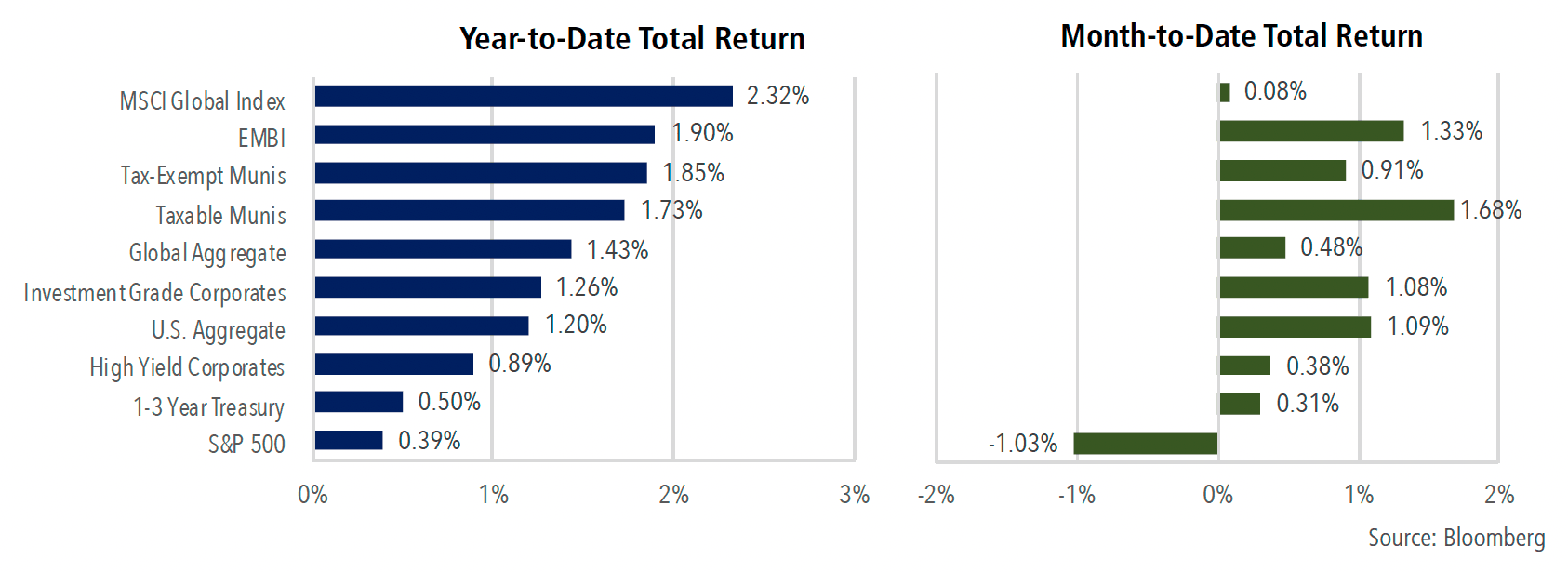
Total Returns by Asset Class
Highlights of the Week:
High Yield: Energy is the top-performing sector in high yield this year, while technology & electronics is the worst. Is the market pricing in a shift from the software economy to the real economy? Or are geopolitical tensions causing short-term impacts on commodity sentiment? Investors should not become complacent—active management remains essential in the current environment.
Corporates: Investment-grade markets saw $27 billion in new issue supply this week, bringing the year-to-date total to $349 billion, roughly 20% higher than the same period last year. More supply is expected, with some dealers raising their 2026 projections to over $2 trillion. Spreads are two basis points tighter at an option-adjusted spread of 77 basis points as of Thursday’s close.
Municipals: For the 13th consecutive week, municipal bond inflows remained positive, with LSEG Lipper reporting an inflow of $1.3 billion into municipal bond funds, bringing the total to $16.6 billion year to date.
Equities: U.S. equities finished the week modestly higher as strong corporate earnings helped offset mixed economic data and rising geopolitical concerns. Sector performance varied, with communications, technology, and industrials leading gains, while consumer staples, materials, and healthcare lagged.
Securitized Products: The collateralized loan obligation (CLO) market experienced mixed spread performance, with a robust new-issue calendar that was generally well absorbed. Ongoing concerns about AI-related disruption across several loan sectors—including software, insurance, and financial services—continued to pressure sentiment, leading to wider spreads in lower-rated CLO tranches. In contrast, investor demand for higher quality remains solid, particularly for short-duration AAA tranches still yielding north of 4.5%, which finished the week on a firm note.
Disclosure: This material reflects the firm’s current opinion and is subject to change without notice. Sources for the material contained herein are deemed reliable but cannot be guaranteed.