During our latest visit to the Andean region, we spent time in Colombia, Ecuador and Peru, three neighbors facing distinct economic circumstances despite a common political trajectory. All three have shifted to the political right in recent years, in line with a broader trend across Latin America. In Colombia and Peru, that shift brought new presidents into office this summer, and our meetings came during the early phase of both administrations, as campaign promises are still being translated into budgets, cabinet appointments and legislative agendas. Ecuador's government is further along, two years into an IMF-supported program aimed at restoring fiscal sustainability and rebuilding buffers needed to safeguard dollarization. Across all three capitals, several shared challenges featured prominently in our conversations, among them the spread of organized crime across porous borders and the region's exposure to El Niño-related climate shocks.
Over the past decade, organized crime tied to drug trafficking has gradually spread well beyond its traditional strongholds, with coca cultivation in Colombia at or near record levels and Ecuador's Pacific ports emerging as a key export route for cocaine produced in Colombia and Peru. Criminal groups operate across the three countries' shared borders, and voter concern over rising insecurity has been a driving factor behind the right's electoral gains in all three. The new governments in Colombia and Peru both campaigned on tougher security policies, and Ecuador's Daniel Noboa won re-election in 2025 on the popularity of the hardline approach he has pursued since declaring an internal armed conflict against drug traffickers in early 2024. All three governments have also moved closer to the United States on security. During a tour of the region in September, U.S. Secretary of State Marco Rubio confirmed Colombia's and Peru's entry into the Shield of the Americas, a U.S.-led anti-cartel coalition that Ecuador helped found in March, alongside a pledged $1 billion security package for Colombia, additional funding and equipment for Ecuador, and Peru's designation as a major non-NATO ally.
Climate risk is the second common theme. The 2023 El Niño contributed to a recession in Peru and disrupted fishing and agricultural output along the coast. In Colombia, the dry conditions that came with the event drew down hydropower reservoirs, pushed up wholesale electricity prices and led to water rationing in Bogotá in 2024. Ecuador, which relies on hydropower for most of its electricity, endured extended blackouts during a 2024 drought, an episode we return to below. The risk is now more immediate, as NOAA assigns a greater than 90% probability to a very strong El Niño during the 2026–27 season, and Colombian wholesale electricity prices have already more than quadrupled this year in anticipation of reduced hydropower output. Officials in all three countries were attentive to the fiscal cost of the coming event and the role of contingent financing in absorbing it.
These shared pressures, however, are landing on economies at very different starting points. Colombia's new government has inherited public finances in urgent need of repair, Ecuador is working to protect the gains it has made under its IMF program, and Peru may finally have the political stability to capitalize on the strongest fundamentals of the three.
Colombia
Colombia offers the clearest illustration of the region's political turn. Its June presidential election marked a material policy shift from the previous administration of Gustavo Petro, the country's first leftist head of state. Abelardo de la Espriella, a lawyer and businessman with no prior experience in elected office, defeated Iván Cepeda, the candidate of Petro's Historic Pact coalition, on a platform centered on public security and the restoration of fiscal discipline. The first pledge tapped into the voter concern described above. The second reflected the economic backdrop: under Petro, public spending rose well ahead of revenue, and by 2025 the central government's primary deficit had reached 3.5% of GDP, a level exceeded only during the 1999 financial crisis and the pandemic years of 2020–21.
Petro's tenure also left Colombia's relationship with the United States, long its closest security partner, severely strained. Ties deteriorated sharply amid disputes over drug policy and U.S. military strikes on suspected drug-trafficking vessels in the Caribbean, and in 2025 the U.S. decertified Colombia as a cooperating partner in counternarcotics efforts for the first time in nearly three decades. Since his inauguration in August, President de la Espriella has moved swiftly on both fronts, repairing relations with the U.S., including through Colombia's entry into the Shield of the Americas, and signaling his commitment to orthodox economic management. Of the two, restoring the public finances will prove the far harder task, and officials characterized the fiscal position they inherited to us as critical and without precedent.
The fiscal position is closely tied to the country's growth story. On the surface, Colombia's recent economic growth compares well with its neighbors. Real output has expanded by about 17% since the end of 2019, the fastest pace among Latin America's six largest economies, and growth accelerated to 2.9% year over year in the first half of 2026. The composition of that growth, however, raises concerns about its durability. Broadly speaking, an economy can grow because households and the government are consuming more, or because investment in equipment and infrastructure is expanding its capacity to produce more output. Both contribute to growth, but higher consumption is only sustainable if investment expands the economy's productive capacity alongside it. Colombia's expansion has relied almost entirely on higher consumption. Real household and government consumption are both nearly 30% above pre-pandemic levels, while real fixed investment remains roughly 10% below where it stood in 2019. The Finance Ministry estimates that investment has fallen to its lowest share of GDP since at least 1975.
Fig. 1
Colombian Congress

Source: Photography by Author
Government consumption alone accounted for roughly 1.9 percentage points of the economy's 2.9% growth in the first half of the year. Growth of this kind is costly in three respects. Because it is financed by government borrowing rather than rising incomes, it can last only as long as deficit spending accelerates. Because it lifts demand without adding to the economy's capacity to supply goods and services, it tends to push up prices and draw in imports, rather than increase output. And because the government's heavy borrowing needs drive up interest rates, it discourages and crowds out the private investment the economy needs. Sustainably raising Colombia's long-term growth rate will depend on reversing this imbalance between consumption and investment.
Reversing it begins with the public finances, and the new government's first step has been to present a more candid picture of them. Its revised figures show a 2026 deficit well above what the previous administration had projected, and officials told us that the 2027 budget they inherited left significant legally mandated spending unfunded, including pensions, health and fuel subsidies. The government has responded with immediate spending cuts this year and plans to submit an Economic Rescue Bill to Congress in October. The bill aims to reduce the primary deficit by nearly 4% of GDP by 2030, with most of the adjustment coming from spending restraint rather than new taxes. The effort is frontloaded, with close to half of it delivered in 2027 alone. The government argues that this would stabilize public debt at around 64% of GDP, compared with a path above 82% by the end of the decade if no action is taken.
Delivering an adjustment of this scale will be politically demanding. Much of Colombia's spending is locked in by the constitution or by law, including transfers to regional governments, pensions and health care, and these rigid items account for roughly three-quarters of the recent rise in spending above its historical trend. Cutting them requires legislation, and in some cases constitutional change, which places Congress, rather than the Presidency, at the center of the effort. Recent history offers limited encouragement. In 2021, a tax reform proposed under President Iván Duque set off weeks of nationwide protests, forcing the government to withdraw the bill and prompting the resignation of the finance minister. The Petro administration fared little better: Congress rejected its proposed financing laws in both 2024 and 2025, and the Constitutional Court struck down the economic emergency decree it then used to raise revenue by executive order. Against this backdrop, the government's decision to rely mainly on spending cuts rather than new taxes may prove more palatable to legislators, but it concentrates the burden on programs with large and vocal constituencies.
Portfolio Perspectives
Our portfolios are generally underweight Colombian sovereign credit but overweight Colombian corporate credit, reflecting where we currently see better relative value. The sovereign underweight is a judgment on valuation rather than a dismissal of the progress made. The new government has diagnosed the fiscal problem candidly and set out a credible plan to address it, and markets have already rewarded the shift through narrower credit spreads and a stronger peso. Even so, Colombian credit still trades at a discount to peers and above its long-run norm, suggesting that markets are encouraged by the direction of policy but not yet convinced it will be fully delivered. In our view, that discount does not yet fully compensate for the risk that the adjustment is diluted in Congress, though it leaves room for further gains if the Economic Rescue Bill passes largely intact. The change in government and the seriousness of its fiscal effort are nonetheless meaningful developments, and we are biased to add sovereign exposure at more attractive valuations, with the progress of the Economic Rescue Bill through Congress central to that assessment.
Ecuador
Where Colombia's challenge is to reverse a deterioration, Ecuador's is to sustain an improvement. Ecuador remains the weaker credit in absolute terms, rated several notches below its northern neighbor, but its trajectory has been moving in the opposite direction. President Daniel Noboa's government has spent the past two years implementing an IMF-supported reform program, and the results have begun to show: growth has exceeded expectations, the country has posted sizable current account surpluses, international reserves have climbed to record highs, and the central government deficit through August narrowed to about 0.7% of GDP from 1.5% a year earlier. In January, Ecuador returned to international bond markets for the first time since 2019. Yet the country's recent history also illustrates how quickly climate shocks can disrupt an improving economic trajectory. In 2024, a severe drought drained the reservoirs behind the hydroelectric plants that generate most of Ecuador's electricity, forcing blackouts of up to 14 hours a day and reducing GDP by 1.4%. With a strong El Niño now on the horizon, the question of whether Ecuador's power grid can withstand the next shock was the main theme of our meetings in Quito.
Fig. 2
National Assembly of Ecuador
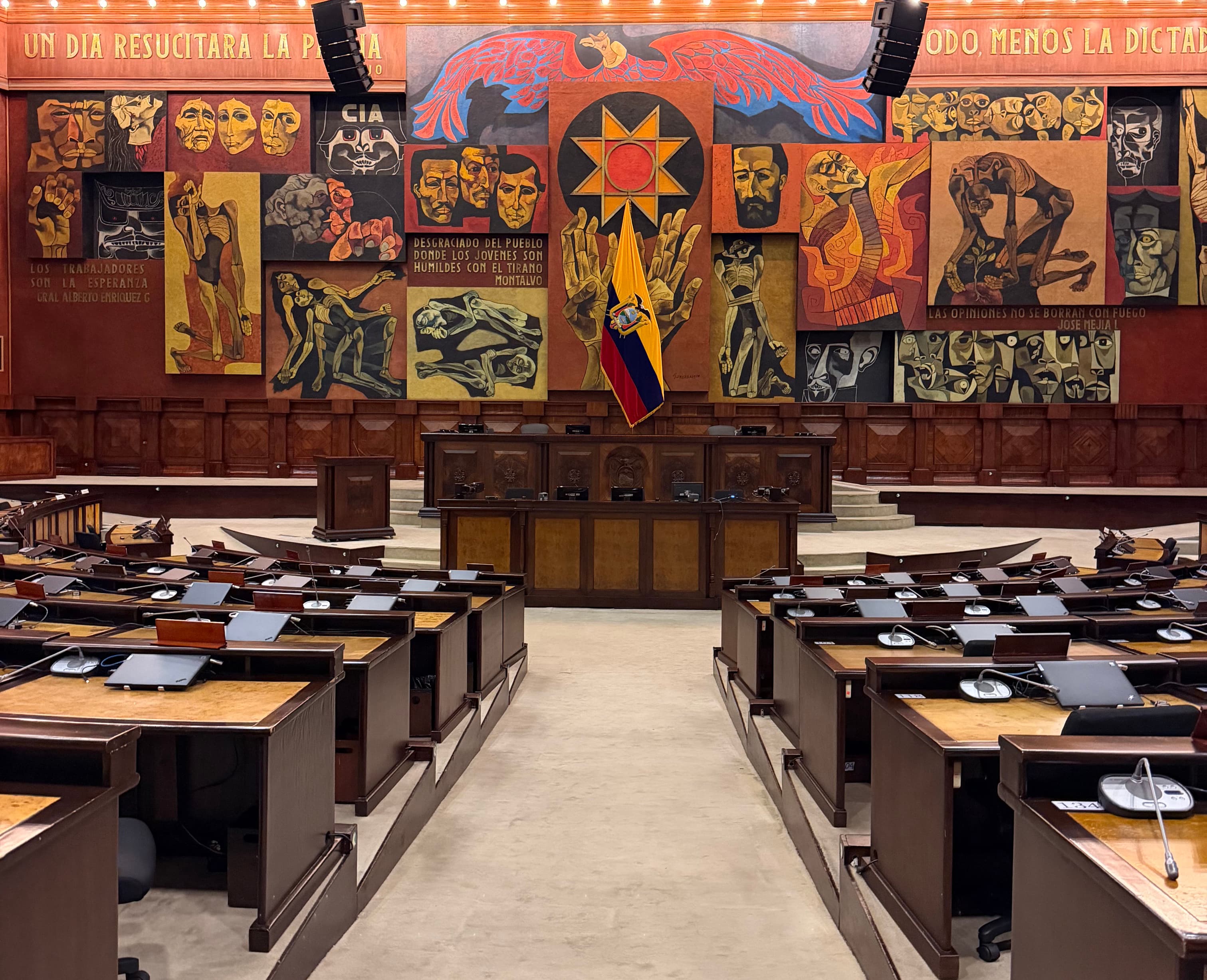
Source: Photography by Author
Since the 2024 crisis, the government has pursued a two-track response to the power shortfall. In the near term, it added backup capacity that does not depend on rainfall, leasing land-based and floating thermal plants and importing electricity from Colombia. The more consequential changes, however, have been structural. To attract private capital into a sector long dominated by state-owned hydroelectric plants, the National Assembly passed a law in October 2024 that raised the size limit on private generation projects tenfold to 100 megawatts, streamlined their approval and allowed distributors to sign long-term purchase agreements with private generators. The Inter-American Development Bank has backed those purchase agreements with guarantees against nonpayment by the state-owned buyer, supporting around a dozen renewable projects, mostly solar and wind, expected to add more than 800 megawatts of capacity and mobilize close to $1 billion in private investment, though most are not expected to come online before 2027. Regulations adopted under the IMF program now also allow businesses to sell surplus self-generated electricity to the grid, and tariffs for large industrial users have been revised to better reflect costs.
The full payoff from these reforms will take time to arrive, however, and this year's dry season is already testing the grid. Apart from emergency thermal capacity added after the 2024 crisis, the grid has gained almost no new permanent capacity over the past year, while demand has risen more than twice as fast as its long-term trend. Officials acknowledge a generation shortfall of roughly 1,000–1,200 megawatts in the coming months. To manage it, the government is carefully drawing down the Mazar reservoir, the system's main reserve, and has asked around 9,000 large and medium-sized businesses to disconnect from the grid one day a week. El Niño adds a further complication. Its effect on rainfall in Ecuador's own hydroelectric basins is difficult to predict, but by reducing rainfall in Colombia, whose own hydropower concerns have already driven up wholesale prices there, it is likely to constrain the imports that have helped Ecuador bridge the gap so far this year. Without them, local economists estimate that Ecuador could face rationing of three to four hours a day in October and November, disruptive but well short of the 14-hour blackouts of 2024. The economic damage may also prove more contained this time, as many businesses invested in their own generators after the last crisis.
Whatever the dry season brings, Ecuador will face it from a position of unusual external strength. A record current account surplus of nearly 6% of GDP in 2025, driven by strong non-oil exports, higher oil prices and steady remittances, has helped international reserves roughly triple since the end of 2023. In a dollarized economy, where the supply of money depends on the amount of dollars entering the country, these inflows have also swelled bank deposits, lowered borrowing costs for businesses and supported a recent pickup in credit growth. This cushion gives the economy considerable room to absorb shocks from power shortages.
The public finances offer a similar cushion, though the government may soon be tempted to draw on it. Spending has accelerated since mid-year, and local economists expect the deficit to widen through year-end, although the IMF program allows for a full-year deficit of around $3 billion that is already fully financed, compared with a deficit of $1 billion recorded year-to-date through August. The timing, however, is sensitive. Ecuadorians will elect mayors, prefects and other local officials on November 29, the month power shortages are expected to be most acute, in an early test of President Noboa's standing in a second term won largely on the popularity of his hardline security policies. Over the past three months, the government has already cut domestic diesel prices despite rising international prices, effectively reintroducing some of the fuel subsidies it removed last year. The direct fiscal cost has been modest, but investors will be watching for any sign that the government is prepared to trade fiscal discipline for electoral support.
The electoral contest itself has also raised concerns. In March, Ecuador's electoral court provisionally suspended Revolución Ciudadana, the leftist movement of former president Rafael Correa and the country's largest opposition force, for nine months amid an investigation into alleged illegal campaign financing. The elections were then moved forward into the suspension period, and an allied movement through which the party sought to field candidates was suspended as well. The government maintains that these are judicial matters, but critics argue that the playing field has been tilted in favor of the ruling party. For investors, the implications cut both ways. A weakened opposition may ease the passage of the government's reform agenda, but sidelining a movement that won around 44% of the vote in last year's presidential runoff risks eroding confidence in Ecuador's democratic institutions and pushing political conflict into the streets, a pattern the country has experienced repeatedly in recent years.
Portfolio Perspectives
After a recent period of underperformance, Ecuador’s dollar bonds offer yields above 10%, which we view as attractive compensation given the country’s improved fundamentals, record reserves, and continued support under the IMF program. January’s debt management operation has also materially reduced the government’s refinancing needs over the next few years. As a result, our portfolios are overweight Ecuadorian sovereign credit. That said, we will monitor risks in the coming months, as the peak of the dry season, the onset of El Niño, and the November elections converge, potentially weighing on market sentiment even if Ecuador’s underlying buffers remain largely intact.
Peru
With Colombia working to repair its fundamentals and Ecuador protecting recently rebuilt ones, Peru's challenge has been of a different kind. It possesses the strongest economic fundamentals of the three, yet for much of the past decade political instability has prevented it from fully capitalizing on them. Congress has removed four presidents since 2020, and Keiko Fujimori, who assumed office in July, is the country's ninth head of state in ten years. Her inauguration, however, likely marks a turning point. Under a revised institutional framework, the threshold for presidential removal has risen considerably, raising the prospect of a government that endures long enough to implement its agenda. The global environment has also moved decisively in Peru's favor. Geopolitical uncertainty has bolstered demand for gold, lifting its price to near record highs, while the energy transition and rising global electricity demand have driven the price of copper, Peru's largest export, to a record high. This has produced a marked improvement in Peru's terms of trade and materially strengthened its external accounts. Private investment has also surged, led by mining, and has so far put little pressure on underlying inflation. For a country whose political dysfunction has often undermined its economic potential, Peru now has a rare opportunity to realize it.
Political scientists have long characterized Peru as a democracy without political parties. Weak, personalistic parties have typically dissolved after a single electoral cycle, and legislators, who were barred from seeking re-election, had little incentive to invest in their parties or cooperate with the executive. The reforms that took effect with this year's elections address these weaknesses. First, the restoration of a Senate for the first time since the early 1990s introduces an additional veto point: removing a president now requires a two-thirds vote in both chambers of Congress, which means a president can survive with the backing of just 21 of 60 senators. Fujimori's Fuerza Popular holds 22 Senate seats on its own. Second, legislators may once again run for immediate re-election, giving them a reason to think beyond a single term and to protect their party's reputation, rather than using their brief time in office to extract short-term concessions from a weakened executive. Third, new electoral rules that exclude parties with only marginal support have produced a far less fragmented Congress: only six parties won seats in this year's election, compared with ten in 2021. Taken together, these changes raise the cost of removing a president while making coalitions easier to assemble and sustain. These reforms are not a guarantee of governability. Fuerza Popular lacks a majority in either chamber and will still need allies to pass legislation. But for the first time in years, Peru's politicians have reasons to cooperate with rather than bring down the President.
If politics has long been Peru's principal weakness, mining has been its enduring strength, and the current cycle has amplified that advantage considerably. Mining accounts for roughly three-quarters of the country's goods exports, and the value of those exports rose by more than 55% in the first seven months of the year. Almost all of this gain reflects higher prices rather than higher output. This distinction is important. Copper's rally rests in part on a structural shortfall in global supply, as demand from electrification and power infrastructure outpaces the development of new mines. The underlying deficit is likely to persist, and Peru appears well positioned to benefit. Mining investment has accelerated year to date, rising by roughly 45% through July, its fastest pace in more than a decade, as companies expand existing operations and advance long-delayed projects. Assuming these projects proceed as planned, Peru should be able to capture the benefits of high copper prices through both rising volumes as well as higher prices.
Fig. 3
Peru Headline CPI Composition
Headline CPI Inflation and Contributions
Sourece: INEI, Macrobond, Payden Calculations.
The windfall from higher metal prices is most visible in Peru's external accounts. The country posted a trade surplus of more than $22 billion in the first half of the year, and the central bank expects a record trade surplus of nearly $50 billion for 2026 as a whole, equivalent to more than 12% of GDP. The current account surplus reached 4.5% of GDP over the past year, its highest level in two decades. These inflows have allowed the central bank to accumulate a formidable stock of international reserves, which stood at roughly $97 billion as of August, equivalent to more than a quarter of GDP and roughly double the ratio in Colombia or Chile. Reserves of this scale give the central bank ample capacity to stabilize the currency during periods of market stress and materially mitigate balance of payments vulnerabilities.
The contrast with Colombia’s consumption-led growth is instructive, because the composition of Peru’s growth has helped keep inflation pressures contained. Headline inflation rose to 4.6% in September, above the central bank’s 1–3% target range. But the pressures are concentrated: transportation and vehicle fuel, roughly a tenth of the consumer basket, account for more than 40% of headline inflation and more than two-thirds of its rise since February. Excluding transportation services, core inflation stood at just 1.8%. The composition of demand explains why. Consumption-driven growth of the kind seen in Colombia competes for domestically produced goods and services and pushes up prices broadly. Investment is different; much of the machinery and equipment for Peru’s mining projects is imported, so a large share of the additional investment demand leaks abroad through imports, while the expansion in productive capacity should ease price pressures over time. Despite the rise in headline inflation year-to-date, the central bank has held its policy rate at 4.25% since September 2025 and expects inflation to return to around 2% as the fuel shock fades. Inflation expectations have edged slightly above the target range and will need monitoring, and the central bank’s latest statement signals greater openness to adjusting policy in the near term. However, with core inflation excluding transport still running below 2%, we think Peru is likely to take a more measured approach to tightening than other economies that have been forced to raise rates recently.
Portfolio Perspectives
We are generally constructive on Peru’s fundamental story, and we have expressed that view in portfolios primarily through exposure to local-currency interest rates, the Peruvian sol, and corporate credit rather than dollar-denominated sovereign debt. With Peru’s sovereign dollar bonds already trading at some of the tightest spreads in the region, we see more attractive relative value in local markets and corporates. Local rates are elevated relative to underlying inflation dynamics, and as the fuel shock fades and headline inflation converges toward the central bank’s target, yields have room to decline. The sol, meanwhile, is supported by record trade and current account surpluses and backed by one of the largest reserve buffers in emerging markets relative to the size of its economy.
This material is intended solely for institutional investors and is not intended for retail investors or general distribution. This material may not be reproduced or distributed without Payden & Rygel’s written permission. This presentation is for illustrative purposes only and does not constitute investment advice or an offer to sell or buy any security. The statements and opinions herein are current as of the date of this document and are subject to change without notice.
This material has been approved by Payden & Rygel Global Limited, a company authorised and regulated by the Financial Conduct Authority of the United Kingdom, and by Payden Global SIM S.p.A., an investment firm authorised and regulated by Italy’s CONSOB. It is directed exclusively at professional investors or eligible parties and counterparties as defined by the rules of the Financial Conduct Authority or, for EU jurisdictions, by the rules of the Markets in Financial Instruments Directive (“MiFID”), as transposed in the relevant EU jurisdictions, and is not intended for use by retail investors. Suitability/appropriateness of the investment is the responsibility of the investor, no assurance can be given that any stated investment objectives will be achieved, and the value of investments may fall as well as rise. This information does not constitute an invitation or offer to subscribe for or purchase any products mentioned which will only be accepted on the basis of the relevant prospectus. The law may restrict distribution of this information in certain jurisdictions, therefore, persons into whose possession this message comes should inform themselves about and observe any such restrictions.
Past performance is no indication of current or future performance, and that it does not take account of the commissions and costs incurred on the issue and redemption of shares.
For institutional use only—not for public distribution.



