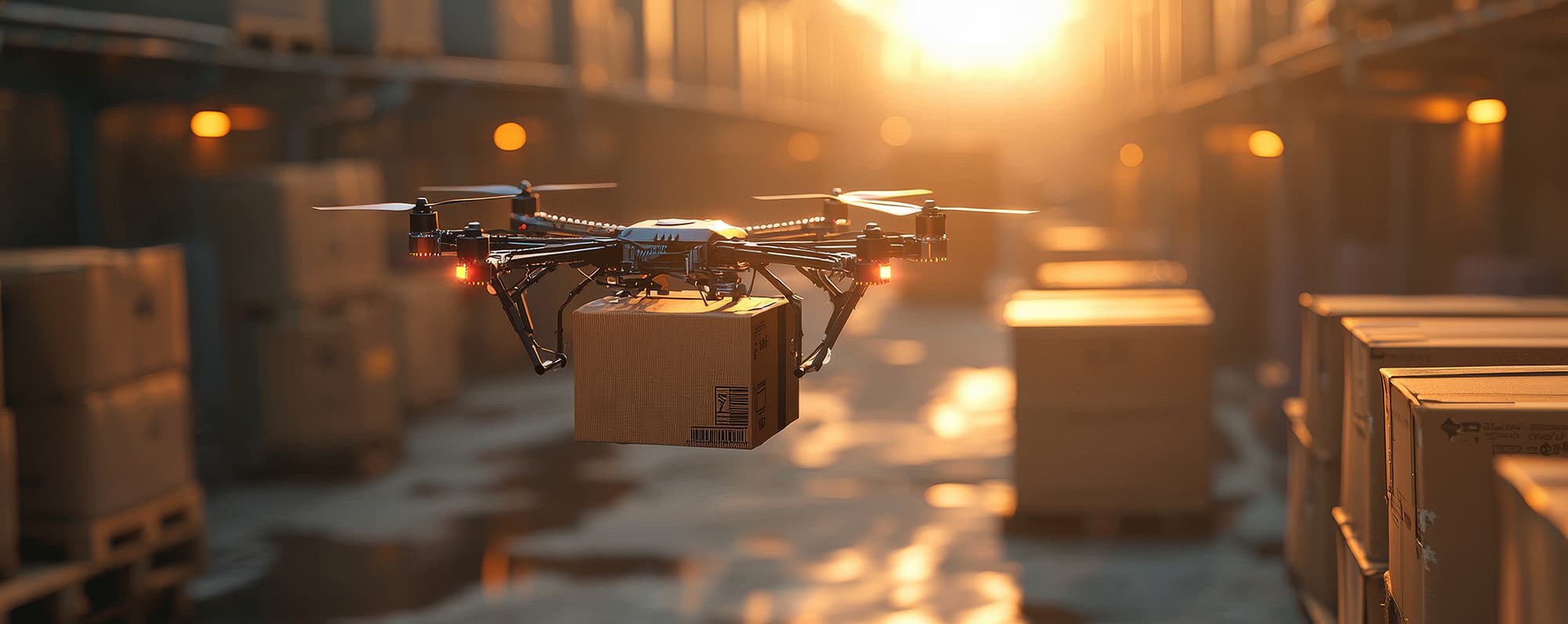
Is it a bird? A plane? Or...Superman?1
Nope. It turns out it’s just piping-hot coffee being delivered by a drone.
If you live in suburban Dublin, you might already be familiar with the above questions, as drone delivery is no longer a science fiction fantasy!
City dwellers often tout the many urban amenities they enjoy, especially the abundance of dining options within walking distance. But, historically, you needed to live in the city to take advantage of the amenities.
Now, at least on the outskirts of Dublin and in a few other locales, all you have to do is pull out a food-delivery app, choose “drone delivery” rather than “road delivery,” and drop a pin on the map where you want the item delivered.
Voilà, you’re all set. Less than three minutes later, you will have your cup of hot joe.2
Below, we explore the process and economics of drone delivery, as well as the possibilities that the success of drone delivery in Dublin is unlocking for the global delivery and freight market.
AirDrops
Drones may soon buzz by to deliver goods in your neighborhood. And, believe it or not, the test case is...coffee? For Manna Air Delivery, a drone delivery service started in Dublin, Ireland, it takes a mere 60 seconds for a human to load the coffee order in the drone before it zips off to its destination.3
The Manna service makes 25 to 30 deliveries per hour, with the autonomous drone “driving” in a straight line, avoiding buildings at an elevation of 250 feet (~80 meters). In abnormal situations, a “pilot” can “drive” the drone out of trouble.
With only light turbulence involved in low-level flights, there’s little risk of spilling your caffeinated beverage, though you might lose two to three degrees Celsius of temperature en route. A small price to pay for a delicious morning beverage?
Once the drone is hovering over your garden, the bay doors open, and the delivery falls four meters per second toward the ground on a string.
Again, your coffee won’t spill. You can even order fresh eggs that don’t break (see Did You Know? The Physics Of An Egg Drop).
Did You Know?
The Physics of an Egg Drop
You might sometimes come across eggs dropping from the sky. But it doesn’t mean the world is ending. It’s because either Manna’s drones are delivering fresh eggs or someone is trying out an egg drop challenge—a common physics experiment exploring how to protect a raw egg from breaking when dropped from the sky (or a drone). Common ways of preventing the egg from breaking include cushioning and parachuting—that’s how they land rockets back on Earth. More creative solutions include orienting the egg so it lands on the sturdiest part of its shell, i.e., vertically! In the case of Manna, they cushion their eggs and drop their deliveries slowly. But the physics behind an egg drop proves a point: As Manna’s CEO Bobby Healy has said, “We deliver fresh eggs, so we can deliver literally anything.”4
Aside from convenience, the most significant positive is the reliability of the delivery time. Drone delivery beats road delivery with impressively quick and precise delivery times.
For example, the average delivery time for Manna is two to three minutes per order, covering an average distance of 1.2 miles. In contrast, a regular “road delivery” over the same distance to Payden & Rygel’s downtown Los Angeles Office took 35 minutes to deliver two coffees! Worse, in suburban Los Angeles, drivers can spend over an hour navigating through traffic. “By the way, the delivery driver is eating your fries!”5 Even if driverless delivery becomes ubiquitous, computer-controlled cars cannot avoid traffic, meaning the drone remains the superior choice.
Delivering High Tech
Several key factors have laid the groundwork for Manna’s success, including the availability of technology, ease of integration, the popularity of the delivery product, and the optimal operating location.
First, the technology required for this “manna from heaven” already existed: GPS tracking, computer vision, drone parts, and batteries. Drone delivery began operating as early as 2013. Since then, advancements in phone technology have made batteries cheaper and lighter. The push for self-driving cars has also led to improved autonomous “driving” algorithms.
Second, integration or consumer adaptation was also easy since the average consumer is already accustomed to ordering delivery through a phone app.
Third, for a drone delivery company like Manna that wants to leverage its high fixed-cost and low variable-cost business model, there’s no better product than Ireland’s most frequent purchase, coffee (more on this below).
Fourth, location matters. Suburbs are ideal for drone delivery. Drones travel quickly (on average, 50 miles per hour) at low altitudes, making them ideal for widespread suburban neighborhoods with low-story single-family homes, which enables almost all drone routes to be straight-line deliveries.
Unit Economics
But we’re an investment management publication, so we must ask: How does drone delivery make money?
Easy: at least in the case of Manna, buyers pay a fixed fee per delivery (EUR 4 or $4.60), but the unit economics built on the above mentioned four key factors of success enable the average delivery cost to be $4.27 and lower—so it’s a cash flow-positive business.
Of the $4.27, labor costs are $1.93, fixed overhead costs are $0.71, and consumables and depreciation are $1.63.6
In a world where labor costs hinder new businesses, one Manna dispatcher could monitor 20 autonomous drones simultaneously. Compared to the average labor cost in Europe of $18 per hour, $1.93 per order is unbeatable by any road delivery.7
Overhead costs are low since the space requirements for loading, take-off, and landing are also minimal: an area covering 12 car parking spaces, for example, can accommodate two shipping containers and support five drones simultaneously.8
Further, since the overhead costs are fixed, the more deliveries are made, the lower the cost of each delivery becomes. Manna’s CEO, Bobby Healy, estimated that the price per delivery could soon “be closer to $3 and even $3.50.”9
Drone Derangement Syndrome (DDS)
We can already hear the critics’ objections. In 2019, we wrote fondly about “micro mobility,” and heard “electric scooters would never be allowed in London” in response. Ha! Readers may now be pleased (or annoyed) that scooters and e-bikes dominate the City of London, zipping along dedicated bike lanes.
So, we’re ready for the drone pushback: “This is different; I don’t want thousands of drones buzzing overhead, ruining the countryside or at least the neighborhood.”
Well, do you know what’s worse than a drone? The noise of regular street traffic or neighbors’ lawn mowers every morning (see Figure 1).
Fig. 1
Neighborhood Nuisances
Decibel Scale Of Typical Noise Levels
Sources: California Department of Transportation, Manna, Decibel Pro
The other critique we expect: “Drones can’t fly in the weather where I live.” Well, Dublin is as great a testing ground as any city. A typical day in Dublin features average cloud cover of 70–80%, sustained winds of 20–30 kilometers per hour (or 12–18 miles per hour) with gusts exceeding 50 km/h (30+ miles per hour), and persistent rainfall over 190 days per year (see Figure 2). Even with an impaired visual line of sight, drones can still rely on GPS to make deliveries.
Fig. 2
A Damp Tradition
Number Of Days With More Than 1 Millimeter Of Rainfall In Dublin
Source: Met Éireann, Gridded Daily Rainfall Dataset
Further, Manna began testing on the outskirts of Helsinki, Finland, in January 2025, and has been making, on average, 100 deliveries a day in extremely cold temperatures and the snowiest weather.10
What TAM Is It?
With the hurdles and objections out of the way, we can return to the opportunity set: How big is the total addressable market (TAM) for drones? Our short answer is that it could be massive.
First, the largest consumer market exists in the U.S., a country that also happens to have almost 70% of its housing units in suburbs, making it ideal for drone delivery such as Manna’s (see Figure 3).
Fig. 3
Suburbs For Success
Occupied Single-Family Housing Units (Detached And Attached) In The U.S.
Sources: U.S. Census Bureau, Energy Information Administration
Second, the food delivery market in the U.S. is already huge, with 5.2 billion orders annually.11 Drone delivery can unlock many hidden food delivery demands that were previously hindered by delivery times and costs. For example, how many people would prefer their ice cream delivered before it melts? Estimates suggest that the food delivery market could expand to 16 billion orders per year.12
Third, we can easily imagine the case for drone delivery expanding to packages (see Did You Know? The “Last Meter” Of Drone Delivery). A growing share of online purchases as a share of retail sales is a perfect proxy for real-time market size (see Figure 4). Manna drones can already deliver up to five pounds in cargo weight—just picture how many items sold online weigh five pounds or less!
Did You Know?
The “Last Meter” Of Drone Delivery
The last mile of delivery, defined as the movement of packages from the final distribution center to individual consumers, is typically the most expensive and challenging part of the traditional goods delivery chain. Integrating drone delivery may reduce the cost of traditional last-mile delivery, which is still dominated by road deliveries. However, the next step (or opportunity?) for drones might be a “last meter” delivery challenge: What’s the best way to “land” packages? As of 2022, approximately 46% of drone deliveries, such as Manna’s, utilized the tether (string) method, which is the most precise method but requires drones to descend to lower altitudes, thus increasing the risk of tangling. Another 35% of drone deliveries use parachutes, which is less precise but allows for longer vertical range deliveries. Less commonly used methods include loading packages at docking stations.13
Fig. 4
Relentless Rise
E-Commerce Sales As A Share Of Total Sales In The U.S.
Source: U.S. Census Bureau
Fourth, drones could supplant freight trucking for high-value, low-weight freight. In addition to consumer use, drones could be used to transfer packages from airports, seaports, and train stations to local warehouses and logistics hubs, or from wholesalers to retailers.
What about second-order effects, as with any economic upheaval?
If living 30 miles from downtown LA is suddenly as tasty as living around the corner from your favorite grocer, drone delivery could open up more housing preferences. Further, as drones replace road deliveries, they will reduce road traffic, accident rates, and greenhouse gas emissions. And long-range drone fleets across seas may be able to bypass port bottlenecks. At the very least, the innovation should make supply chains more resilient and prevent supply-chain crises like those experienced during the Covid-19 pandemic.
The Flight Forward
It took more than four years for drones to be approved to fly overpopulated areas legally in Dublin.
Further, Europe’s proactive stance on regulating emerging technologies already sets up a framework of regulations for drones. Contrary to common belief, the fragmented regulation landscape in Europe has allowed drones to be approved more easily, depending on the country.
Meanwhile, the free market-loving and allegedly regulatory-light U.S. still faces legal concerns surrounding low airspace privacy issues above homes. Perhaps Manna’s example could push for friendlier U.S. drone delivery regulations to replace the current rules that restrict existing drone infrastructure like “Amazon Prime Air” to only a few localities.
While we wait for U.S. drone regulations, Manna’s success suggests that a future with drone delivery has already taken off—and we are buckling up for the ride.
Endnotes
Superman (1940s animated film series). (2025, June 26). In Wikipedia. https://en.wikipedia.org/wiki/Superman_(1940s_animated_film_series)
Thompson, B. (Host). (2025, February 20). An Interview with Manna Founder and CEO Bobby Healy About Drone Delivery [Audio podcast]. Stratechery. https://stratechery.com/company/manna/
Manna Air Delivery. Instagram. https://www.instagram.com/p/CUH7-cgAjay/.
Fankel, J. (2022). CEO SERIES Episode 2: A Conversation with Manna CEO Bobby Healy [Video]. Ff Venture Capital. https://ffvc.com/ceo-series/a-conversation-with-manna-ceo-bobby-healy/
Thompson (2025).
Barry, J. T. (Host). (2024, July 2). Bobby Healy, Manna: Unveiling the unit economics behind profitable drone delivery [Audio podcast]. The Vertical Space. https://theverticalspace.net/episode/70-bobby-healy-manna-unveiling-the-unit-economics-behind-profitable-drone-delivery
Ibid.
Kesteloo, H. (2025, April 12). Manna Aero’s drone delivery revolution: Scaling Dublin success to UK and beyond. DroneXL.co. https://dronexl.co/2025/04/12/manna-aero-drone-delivery-revolution/
Barry, J. T. (2024).
Bogaisky, J. (2025, April 2). This Irish drone startup is aiming for a million deliveries a year. Forbes. https://www.forbes.com/sites/jeremybogaisky/2025/03/26/drone-delivery-manna-amazon-wing-zipline/
Barry, J. T. (2024).
Ibid.
Cornell, A., Miller, B., & Riedel, R. (2023, May 5). Solving the “last-meter” challenge in drone delivery. McKinsey & Company. https://www.mckinsey.com/industries/aerospace-and-defense/our-insights/future-air-mobility-blog/solving-the-last-meter-challenge-in-drone-delivery
This material reflects the firm’s current opinion and is subject to change without notice. Sources for the material contained herein are deemed reliable but cannot be guaranteed. This material is for illustrative purposes only and does not constitute investment advice or an offer to sell or buy any security. Past performance is no guarantee of future results. Point of View articles may not be reprinted without permission. We welcome your comments and feedback at editor@payden.com.
This material has been approved by Payden & Rygel Global Limited which is authorised and regulated by the Financial Conduct Authority. This material has been approved by Payden Global SIM S.p.A.. which is authorised and regulated by CONSOB.